1. What the 30-trillion-won R&D budget signals
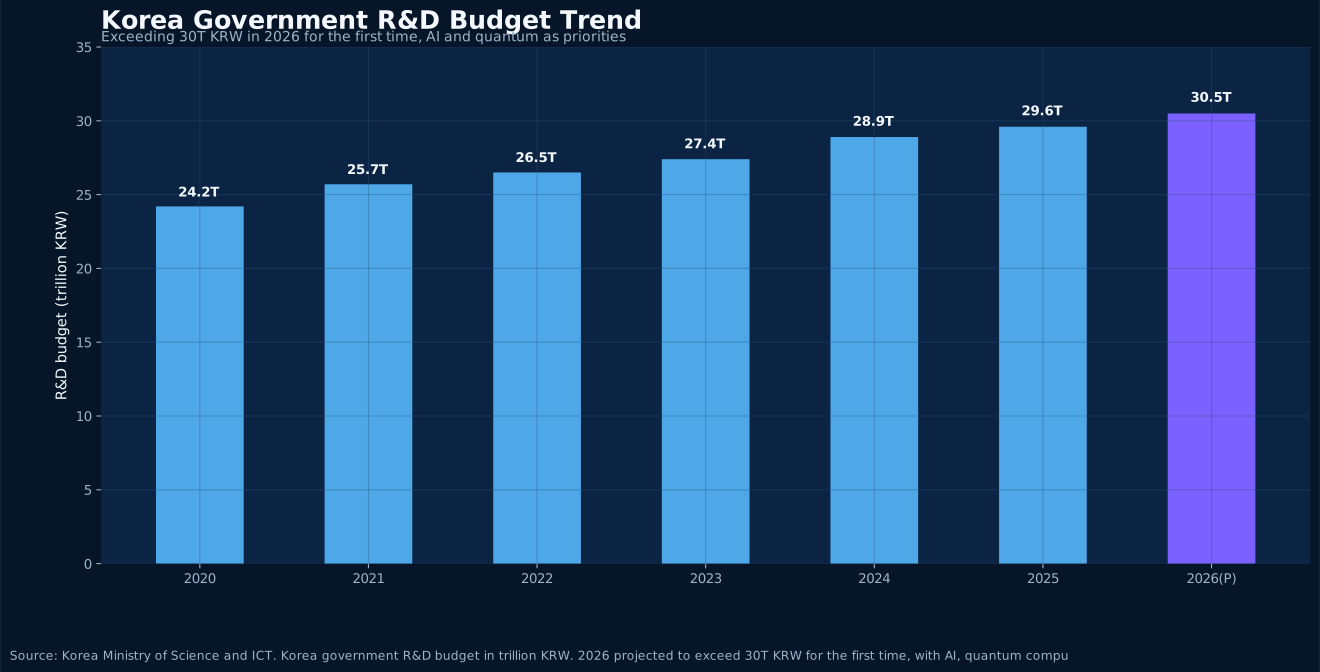
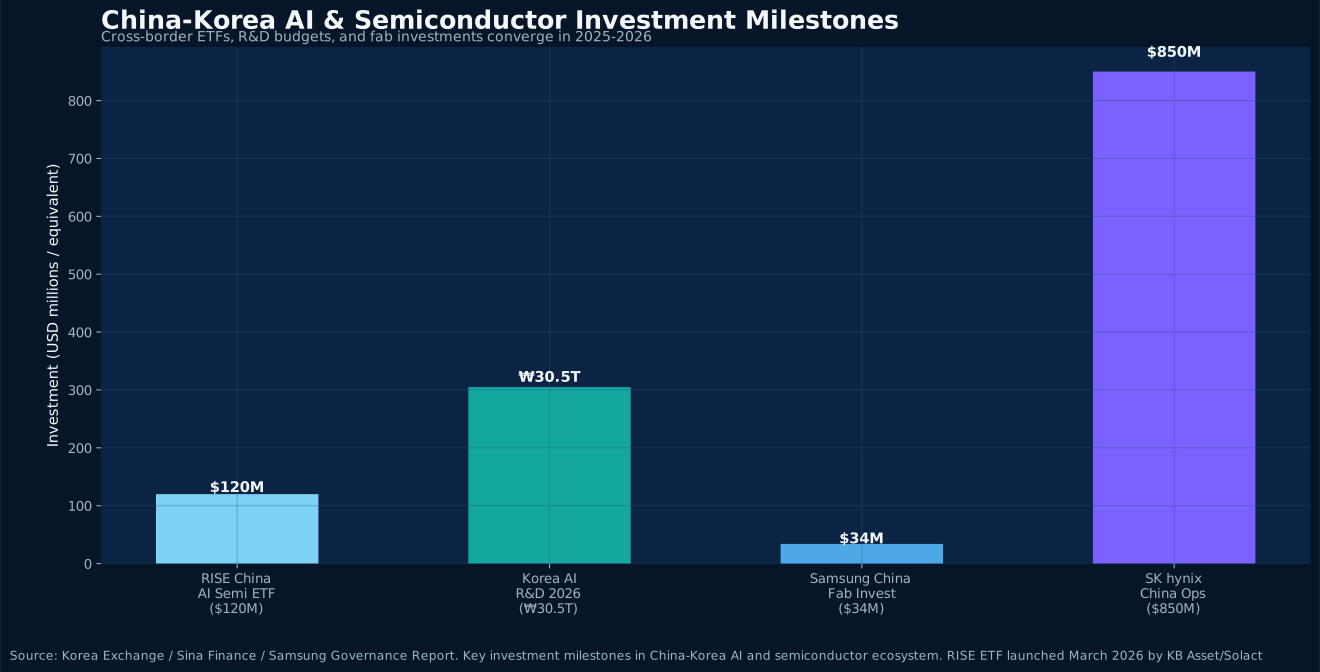
Korea’s government R&D budget for 2026 is projected to exceed 30 trillion KRW for the first time, setting a new historical high. The largest growth areas are artificial intelligence, quantum computing, and biotechnology. From 24.2 trillion KRW in 2020 to 30.5 trillion now, the cumulative increase over six years is 26%, with an annual growth rate exceeding 4%. This sustained escalation reflects Korea’s strategic urgency in the global AI race.
But Korea’s R&D investment does not exist in isolation. It forms a subtle complementary relationship with China’s AI industry: Korea leads globally in semiconductor hardware, memory chips, and advanced packaging, while China has clear advantages in AI algorithms, application scenarios, data scale, and platform ecosystems. This “strong hardware + strong applications” complementary structure is the core foundation for China-Korea AI cooperation.
2. Cross-border AI-themed ETFs: capital market scouts
In March 2026, German index company Solactive and Korea’s KB Asset Management jointly launched the “RISE China AI Semiconductor Top 4+” ETF, specifically tracking core companies in China’s AI semiconductor value chain. This marks the first time Korea’s capital market has directly linked to China’s AI industry via an ETF product—a signal whose significance extends well beyond the product itself.
The emergence of such ETFs reflects genuine Korean investor interest in China’s AI industry. Previously, China’s Shenzhen Stock Exchange held a promotional event in Seoul, highlighting Chinese AI and robotics assets to Korean investors. When capital markets begin embracing Chinese AI assets through dedicated products, it signals that China-Korea cooperation in this domain has moved from “future tense” to “present continuous.”
3. Semiconductor equipment trade: a delicate balance under U.S. controls
China-Korea AI cooperation cannot avoid the sensitive topic of semiconductor equipment trade. U.S. export controls on chips to China have directly impacted Korean companies’ China operations. China’s semiconductor equipment imports from Korea fell to $4.476 billion, a 20.3% decline year-on-year. Samsung and SK hynix had their China factory upgrade and expansion plans visibly constrained, triggering chain reactions across the supply chain.
But recent developments show this picture is subtly shifting. Samsung and SK hynix have received U.S. approval to export chip manufacturing equipment to China in 2026, transitioning to an annual quota review model. Samsung’s governance report shows $34 million in new equipment was added to its China factories last year. This demonstrates that despite complex controls, China-Korea semiconductor trade has not been fully severed—it is finding new ways to operate under new rules.
4. Application-layer collaboration: smart cities, industrial IoT, and the silver economy
Beyond hardware and capital connections, China-Korea AI cooperation holds enormous potential at the application layer. Both countries face aging population challenges, making the “silver economy” a shared testing ground for AI applications. In smart nursing robots, remote health monitoring, and age-friendly home systems, Korea excels in sensor hardware and UX design while China leads in algorithm optimization and large-scale deployment.
Smart cities and industrial IoT are another key cooperation axis. Korea’s smart city technologies already have export track records in Southeast Asia and the Middle East, while China possesses the world’s largest smart city application landscape. The two countries have strong synergy potential in “technology export + scenario implementation.” Under the China-Korea FTA and RCEP frameworks, trade facilitation for technology services is improving.
5. Structural constraints facing China-Korea AI cooperation
Despite clear complementarity, China-Korea AI cooperation faces multiple structural constraints. U.S. export control policy is the largest external variable, affecting not only hardware trade but also creating chilling effects on the boundaries of technology collaboration. When Korean companies must balance between the U.S. and China, the pace and scope of cooperation are inevitably affected.
Additionally, cross-border data flows, intellectual property protection, and differences in technical standards are potential obstacles. China and Korea have different legislative approaches to AI ethics and data governance, which can slow data-intensive collaborative projects. But from another angle, these constraints also mean that companies capable of navigating compliant cooperation paths in complex environments will gain outsized competitive advantages.
6. Outlook: AI cooperation will reshape the China-Korea trade structure
Looking ahead, AI cooperation may become a key force reshaping the China-Korea trade structure. Current bilateral trade still centers on traditional industrial goods like semiconductors, chemicals, and steel, but AI is injecting new technological content into these conventional flows. When China’s AI algorithms combine with Korea’s hardware capabilities, bilateral trade will evolve from “product transactions” to “technology ecosystem co-building.”
For China-Korea trade practitioners, AI is no longer a distant technology topic—it is a real force reshaping trade patterns. From cross-border ETFs to factory investments, from R&D budgets to application scenarios, every link in the China-Korea AI industry chain is evolving. Understanding this trend early will help companies secure favorable positions in the next wave of bilateral trade upgrading.