1. Hallyu exports evolve from cultural phenomenon to economic pillar
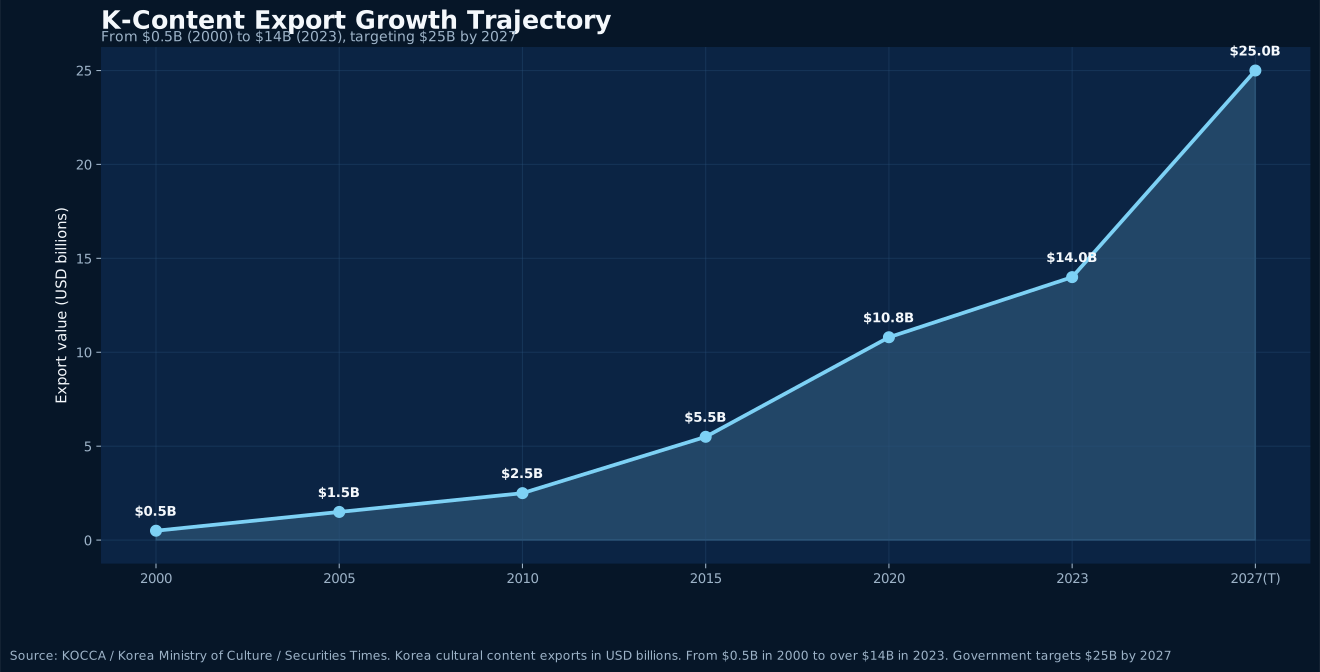
The growth trajectory of Korea’s cultural content exports is striking. From just $500 million in 2000, the figure surpassed $14 billion in 2023, representing a compound annual growth rate exceeding 15%. The Ministry of Culture, Sports and Tourism has set a target of $25 billion by 2027, at a 12.3% annual rate. This sector has become Korea’s second-largest export earner after automobiles, with K-pop, K-drama, games, webtoons, and digital content forming a vast cultural export ecosystem.
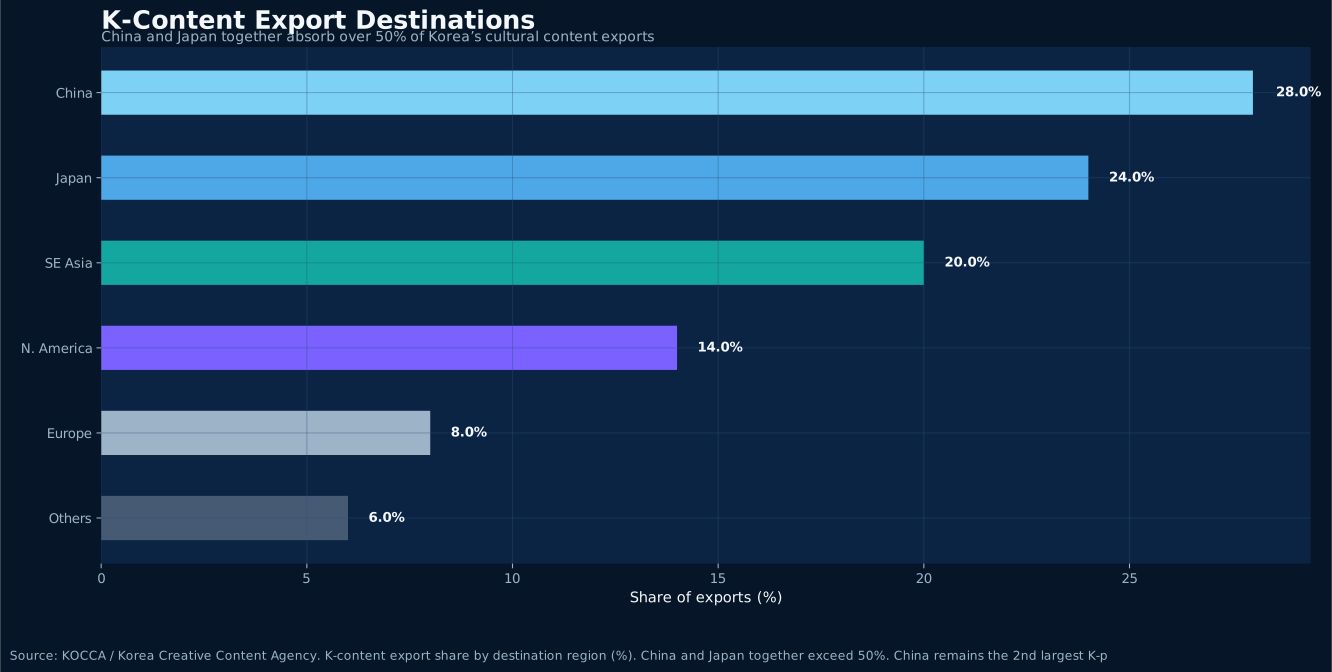
But this growth is not evenly distributed. China and Japan together absorb over 50% of K-content export value, with China alone accounting for 28%. Any policy shift in China significantly impacts the Hallyu economy. In recent years, China’s policy environment toward Korean cultural content has fluctuated delicately, pushing the Korean content industry to simultaneously pursue diversification and “rediscover China.”
2. After the “Hallyu ban”: policy relaxation meets commercial reality
The 2016 “Hallyu ban” had a profound impact on Korean cultural content distribution in China. K-drama releases, celebrity appearances, and game license approvals all faced varying degrees of restriction. In recent years, however, as China-Korea relations have warmed overall, some restrictions have begun to ease. Early 2026 has been called the “year of full restoration” for the bilateral relationship, with Korea’s new president explicitly expressing willingness to upgrade economic cooperation, including cultural exchanges on the agenda.
But a time gap remains between policy relaxation and commercial implementation. Korean game companies still await new license approvals, and K-drama listings on major Chinese platforms, while recovering, remain far below pre-2016 levels. The real commercial opportunities currently concentrate in “edge” domains: webtoons, short-form video content, IP-licensed merchandise, and the “Hallyu economy” pull-through effect on platforms like Xiaohongshu and Douyin. These “micro-cross-border” channels are redefining how Korean content enters China.
3. The full “Hallyu economy” chain driven by K-pop and K-drama
The economic value of Hallyu extends far beyond content export figures. Every hit K-drama generates knock-on effects in cosmetics, fashion, food, and tourism. The “Hallyu economy” is essentially a composite ecosystem where content triggers consumption and commodity trade is the monetization layer. Data shows that China accounts for 36% of K-pop album exports, consistently ranking as the second-largest destination. This is not just a music industry story—it is the entry point to the entire Hallyu-driven trade chain.
For Chinese enterprises, this Hallyu effect also creates reverse opportunities. When Korean content regains exposure in China, Chinese companies providing OEM, packaging, or ingredient supply to Korean beauty, food, and fashion brands benefit indirectly. Hallyu is not only Korea’s export tool—it is also a market amplifier for China’s supply chain.
4. Southeast Asia, North America, Europe: Hallyu’s “second curve” markets
While China and Japan remain core Hallyu markets, the Korean content industry is actively building “second curve” positions. Southeast Asia holds 20% of export share, North America 14%, and Europe 8%, with all three growing faster than the overall average. Global streaming platforms like Netflix and Disney+ are accelerating Korean content penetration in English-speaking markets through large-scale acquisition deals.
For China-Korea trade, however, this diversification does not mean the Chinese market will be marginalized. On the contrary, when Hallyu’s global brand value increases, its pull effect on the Chinese market actually strengthens. A globally recognized Hallyu IP typically monetizes more efficiently in China. For Chinese companies participating in the Hallyu supply chain, this is an important structural tailwind.
5. What Korea’s “policy-enabled” Hallyu model means for China’s cultural exports
Hallyu’s success is not purely market-driven—it is a systematic “policy + industry + platform” engineering effort. The Korean government has systematically lowered the overseas expansion costs for cultural enterprises through KOCCA, exhibition subsidies, and Hallyu experience centers. This model offers direct reference value for China’s cultural export strategy.
From a China-Korea trade perspective, the growth of the Hallyu economy signals bidirectional opportunities. Hallyu drives awareness and demand for Korean consumer goods in China, while China’s content production capabilities, technology platforms, and massive market scale attract Korean content companies to seek partnerships. The biggest future space in China-Korea cultural trade may lie not in “who sells to whom” but in “joint development.”
6. Outlook: the next decade of the Hallyu economy
The Korean content industry’s next decade will be shaped by two key variables: AI’s transformation of content production and shifts in the competitive dynamics of global streaming platforms. As AI dramatically lowers production costs, Korean content companies must build new moats in creative quality and cultural depth rather than relying solely on production scale. Meanwhile, China’s own rapid development of AI content tools and platforms creates new interfaces for China-Korea collaboration at the content technology layer.
For China-Korea trade practitioners, the Hallyu economy is not just a cultural topic—it is a tangible trade opportunity indicator. As K-content continues to break through ceilings, the trade volumes it drives in cosmetics, food, tourism, and education may be multiples of the content export figure itself. Viewing “culture” and “trade” in isolation means missing the most important commercial logic of this era.