1. Policy Context: Why Beijing Is Pulling the Rebate Now
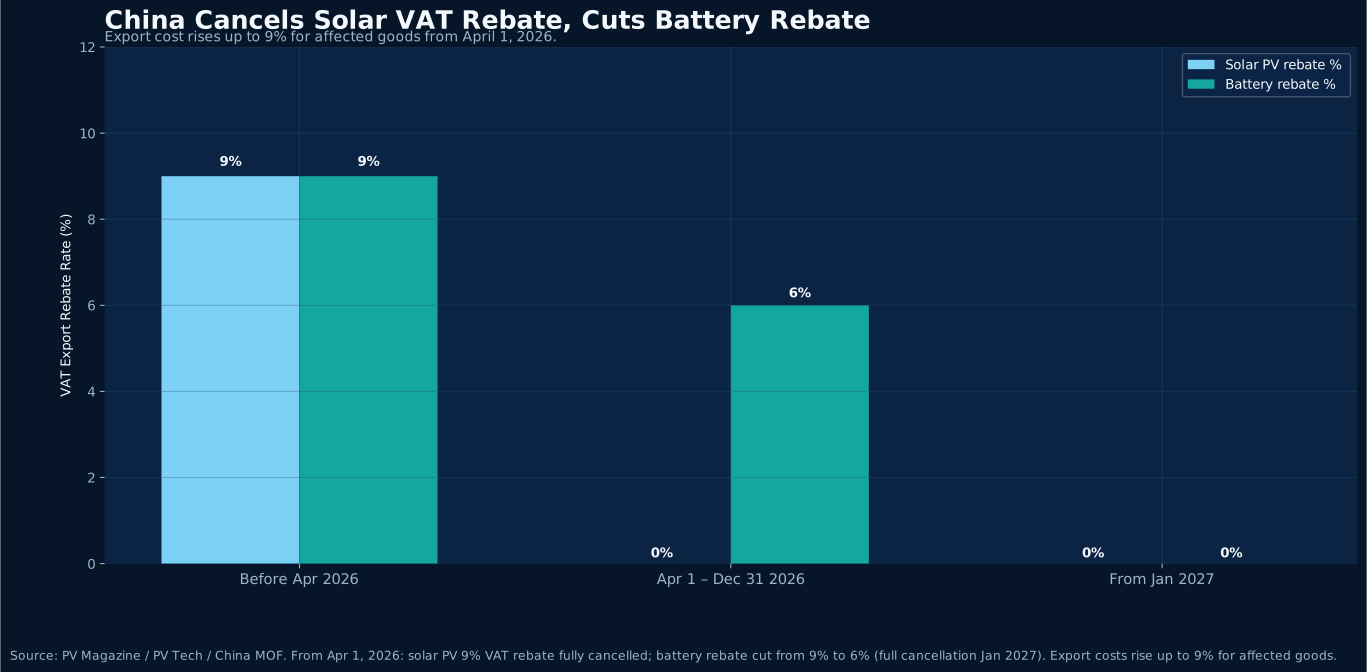
On January 9, 2026, China's Ministry of Finance and State Tax Administration jointly announced the full cancellation of the 9% VAT export rebate on solar PV products from April 1, while cutting battery product rebates from 9% to 6% with full phase-out from January 1, 2027. The policy shift reflects multiple pressures: escalating trade friction over Chinese solar and battery products worldwide, with the EU, US, and India imposing tariffs or launching anti-subsidy investigations. Beijing's move is widely seen as a proactive de-escalation — reducing export subsidies to counter accusations of price dumping.
A researcher at the Chinese Academy of International Trade and Economic Cooperation stated plainly: "This adjustment responds to the international community's concerns about our PV products — many countries have already imposed tariffs. Canceling export rebates helps ease the situation we face in international markets." From another angle, severe domestic PV overcapacity is a major driver — China's solar module capacity exceeded 800 GW in 2025 against global demand of roughly 500 GW, with utilization below 65%. The rebate cancellation sends a clear capacity consolidation signal to the industry.
2. Policy Details: Solar to Zero, Battery in Two Steps
Specifically, the adjustment covers two major categories. For solar PV, the full value chain — polysilicon, wafers, cells, and modules — sees the export rebate drop from 9% to 0% effective April 1. This means for every 1 yuan of PV product exported, the 9 cents of VAT previously refundable is no longer returned, directly pushing up export costs by approximately 9 percentage points. For module manufacturers already operating on razor-thin margins, this represents a significant burden.
For batteries, a phased exit strategy was adopted. Between April 1 and December 31, 2026, the rebate rate drops from 9% to 6%; from January 1, 2027, it is fully cancelled. This buffer design gives battery manufacturers roughly 9 months to adjust. Affected products include not only grid-scale battery packs but also key upstream chemicals and inputs. Notably, in the nearly three-month transition between announcement and implementation, a wave of accelerated shipments was expected as companies rushed to lock in rebate benefits — China's Q1 2026 battery exports saw a temporary spike as a result.
3. Direct Impact on Korea: Battery Materials Are the Biggest Pain Point
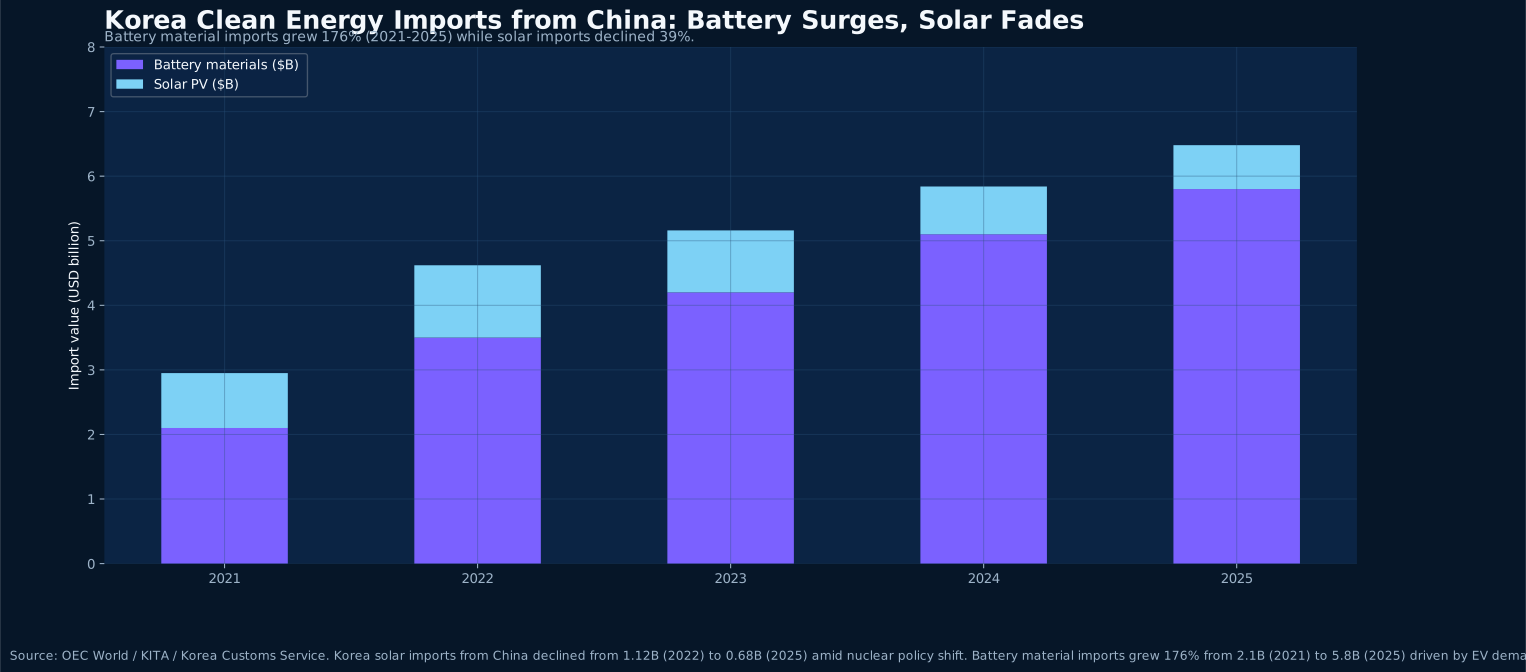
For Korea, the policy's impact must be analyzed by category. On the solar side, Korea's clear pivot toward nuclear-led energy strategy has seen new solar installations decline from 4.4 GW (2022) to 3.1 GW (2024), with PV imports from China falling from $1.12 billion (2022) to $0.68 billion (2025). The solar rebate cancellation thus has relatively limited direct impact on Korea — the country is already reducing PV imports.
The real concern for Korean companies lies in battery materials. Korea's Big Three battery makers — LG Energy Solution, Samsung SDI, and SK On — rely heavily on Chinese cathode materials, separators, electrolytes, and other critical inputs. From 2021 to 2025, Korea's battery material imports from China surged from $2.1 billion to $5.8 billion, a 176% increase. While the rebate cut from 9% to 6% represents only a 3 percentage-point gap, for a category with nearly $6 billion in annual imports, the cost impact reaches $150-200 million. More critically, when rebates drop to zero in 2027, cost pressure will amplify further.
4. Supply Chain Restructuring: Korean Companies' Response Strategies
Facing rising costs from rebate cancellation, Korean companies are responding on multiple fronts. First, they are accelerating alternative capacity in Southeast Asia — LG Energy Solution's cathode plant in Indonesia began production in 2025, and Samsung SDI's electrolyte project in Malaysia is underway. These moves not only avoid the impact of China's rebate changes but also leverage local tax incentives and trade agreement benefits. Second, they are deepening long-term agreements with Chinese suppliers, locking in prices and volumes to hedge short-term cost volatility.
A third strategy worth watching is maximizing China-Korea FTA tariff reduction windows. Under the FTA's tariff schedule, duties on certain battery materials have already been or will soon be reduced to zero. Companies that accurately leverage FTA preferential certificates of origin can partially offset the cost increase from rebate cancellation. For intermediaries and trade agents serving China-Korea commerce, helping clients navigate FTA rate applicability and optimize customs declarations is becoming a high-value added service.
5. Global Chain Reactions and Trade Pattern Reshaping
China's rebate policy change affects not just bilateral China-Korea trade but is part of a broader reshaping of global clean energy trade. After the rebate cancellation, Chinese PV module export prices are expected to rise 5-9%, directly affecting global solar installation costs. Markets dependent on Chinese PV products — Europe, Middle East, Africa — will feel price transmission pressure. Meanwhile, Southeast Asian PV and battery manufacturing capacity is expanding rapidly — Vietnam, Thailand, and Indonesia have become popular destinations for Chinese firms building overseas plants, whose products exported to Korea can avoid the impact of China's rebate changes.
For Korea's trade service firms, the rebate policy change brings not just challenges but transformation opportunities. Demand for professional services skilled in tariff rules, FTA provisions, and supply chain optimization is rising markedly. Trade service providers who can offer Korean buyers 'China + Southeast Asia' dual-track sourcing solutions and help companies find optimal cost paths amid rebate changes will hold advantageous positions in this reshuffle. The rules of clean energy trade are being rewritten, and firms that read rule changes well are often the first to capture new growth space. Author: Minghao, MO-TEK International Trade (Shanghai)