1. China’s hydrogen industry: the world’s largest production system is in place
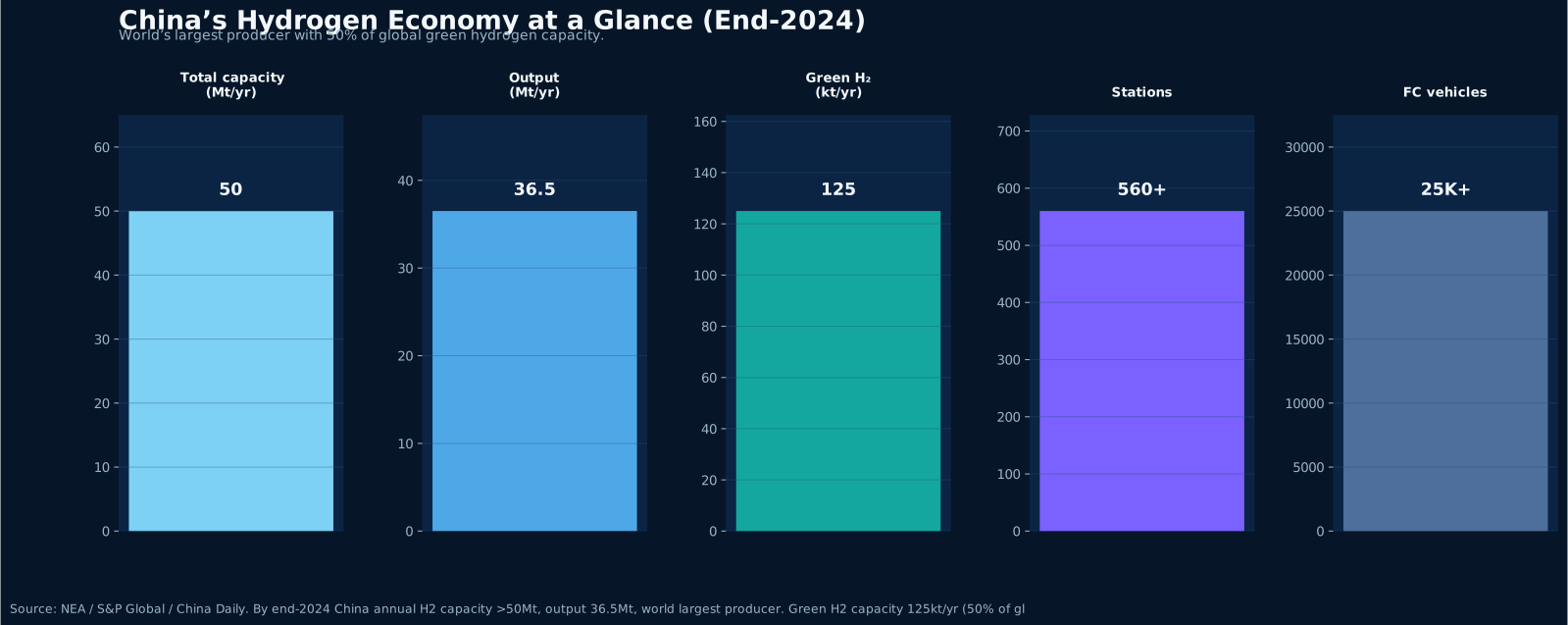
By the end of 2024, China’s annual hydrogen production capacity exceeded 50 million tons, with actual output reaching 36.5 million tons—firmly the world’s largest hydrogen producer and consumer. Even more notable is the rapid rise of green hydrogen: according to China’s National Energy Administration, established green hydrogen capacity reached 125,000 tons/year, representing 50% of the global total. In 2024 alone, China added 35 green hydrogen projects with 48,000 tons of new capacity, a 62% year-on-year increase.
China’s hydrogen infrastructure has developed equally fast. Over 560 refueling stations are operational nationwide, with more than 25,000 fuel cell commercial vehicles on the road—both global firsts. China’s 15th Five-Year Plan (2026–2030) identifies hydrogen as a core green transition direction, targeting large-scale industrial green hydrogen substitution and regional self-sufficiency in renewable-powered hydrogen production. This full-chain approach gives China comprehensive advantages from upstream production through midstream storage and transport to downstream application in the global hydrogen competition.
2. Korea’s hydrogen market: station doubling and fuel cell vehicle leadership
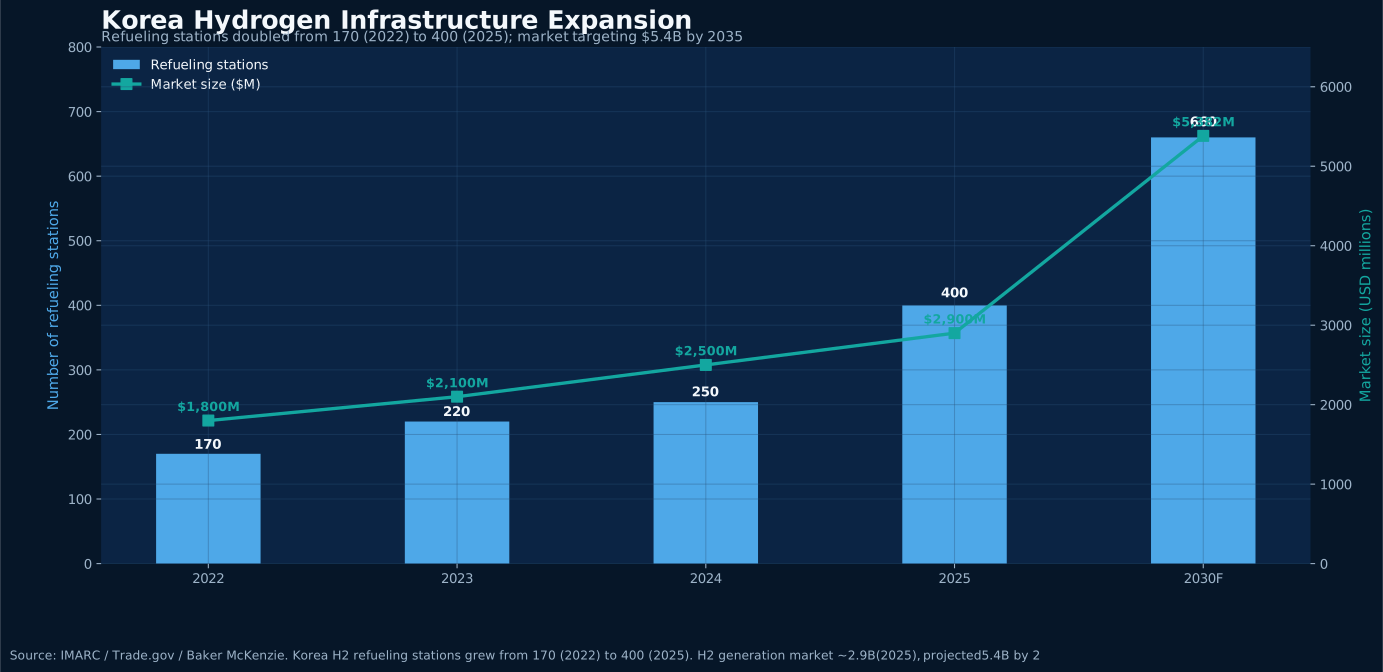
Korea leads globally in hydrogen end-use applications. By early 2025, domestic refueling stations had grown from 170 in 2022 to approximately 400, more than doubling. Korea’s hydrogen generation market is valued at ~$2.9 billion (2025), projected to reach $5.4 billion by 2035 at a 4.88% CAGR. The government has set a long-term target of producing over 5 million tons of clean hydrogen by 2040, with plans to expand refueling stations beyond 660 by 2030.
Korea’s positioning in hydrogen fuel cell vehicles is particularly strong. Hyundai’s NEXO is one of the world’s best-selling hydrogen fuel cell passenger vehicles, and Hyundai is developing a second-generation fuel cell system targeting 800+ km range. Korea also leads globally in hydrogen fuel cell power generation—Doosan Fuel Cell is one of the world’s largest stationary fuel cell manufacturers, exporting to Asian and European markets. Korea’s hydrogen strategy centers on the “hydrogen economy” concept: restructuring energy, transportation, and industry around hydrogen.
3. Complementary logic: China’s production cost advantage meets Korea’s end-use technology
China-Korea complementarity in hydrogen is expressed through upstream-downstream value chain division. China’s advantage lies upstream—abundant renewable energy resources (especially wind and solar in the northwest) make green hydrogen production costs far lower than Korea’s. Chinese electrolysis equipment costs are roughly one-third of European equivalents, with alkaline electrolyzer localization exceeding 90%. This cost advantage makes “produce in China, export to Korea” an economically viable pathway.
Korea’s advantage lies downstream—fuel cell system design, hydrogen vehicle integration, refueling station operation, and commercial hydrogen power generation, where Korea has accumulated world-leading technology and operational experience. Hyundai’s fuel cell technology, Doosan’s stationary fuel cell systems, and Hanwha’s solar + hydrogen integrated solutions are all representative products. The two countries form a natural complementary structure across the produce-store-transport-apply chain, providing a solid industrial foundation for bilateral trade and technology cooperation.
4. Cooperation models: from equipment trade to joint project development
China-Korea hydrogen cooperation is evolving from simple equipment trade to multi-layered models. The first layer is equipment and materials trade. Korea’s refueling station expansion requires compressors, storage tanks, and dispensing equipment where Chinese products offer strong value. Meanwhile, Korean fuel cell MEAs, bipolar plates, and other core components need Chinese upstream materials like carbon paper, catalyst supports, and proton exchange membranes.
The second layer is joint project development. Large-scale green hydrogen projects in northwest China are attracting Korean corporate attention. Hanwha, SK E&S, and other Korean energy companies are exploring wind-solar hydrogen production collaborations in Inner Mongolia and Xinjiang with Chinese partners. The third layer is standards and certification harmonization. Both countries are working through ISO’s hydrogen technology committee to align refueling station safety standards, fuel cell testing standards, and green hydrogen certification systems. This multi-layered model means the scale and depth of China-Korea hydrogen trade will expand significantly over the next five years.
5. Policy frameworks: synergy between China’s 15th Five-Year Plan and Korea’s Hydrogen Economy Act
China’s 15th Five-Year Plan (2026–2030) designates hydrogen as a strategic emerging industry priority. The plan explicitly calls for large-scale green hydrogen deployment in industrial decarbonization, expanded fuel cell commercial vehicle demonstrations in transportation, and exploration of hydrogen storage combined with grid peak-shaving. To achieve carbon neutrality, China will need to produce over 80 million tons of hydrogen annually by 2060, with 70–80% from green energy. This implies an unprecedented expansion of China’s hydrogen industry over the next three decades.
On Korea’s side, the 2020 Hydrogen Economy Promotion and Hydrogen Safety Management Act provides the legal framework, with a 2022 revision expanding policy support. Korea plans to invest $43 billion in renewable energy projects with hydrogen as a key focus. The policy synergy between both countries is clear: China’s scaled hydrogen production can supply low-cost green hydrogen to Korea’s end-use market, while Korea’s hydrogen commercialization experience can provide technology references and market validation for China’s hydrogen rollout. Under RCEP and the China-Korea FTA, cross-border trade in hydrogen equipment and materials will gain further tariff benefits and customs facilitation.
6. Outlook: hydrogen as a core pillar of China-Korea green trade
Hydrogen is becoming a critical variable in the global energy transition, and the complementarity between China and Korea in this field is exceptionally strong by global standards. China possesses the world’s largest hydrogen production system and lowest green hydrogen costs, while Korea has the most mature fuel cell vehicle commercialization system and densest refueling network per unit area. As China’s 15th Five-Year Plan green hydrogen expansion aligns with Korea’s hydrogen economy roadmap, a cross-border cooperation system spanning the entire produce-store-transport-refuel-apply chain is taking shape.
For China-Korea trade practitioners, hydrogen is no longer a “future concept” but a materializing business reality. From electrolyzer equipment exports to carbon paper and catalyst material supply, from joint green hydrogen project development to refueling station technology cooperation, every link offers concrete trade and investment opportunities. Chinese suppliers who position early—especially those with cost and technology advantages in electrolysis equipment, hydrogen storage materials, and upstream fuel cell components—will occupy significant positions in the next decade of China-Korea green trade. Hydrogen is not just an energy transition tool; it is a new engine reshaping the bilateral trade structure.