1. Korea officially enters super-aged status: the world’s fastest aging curve
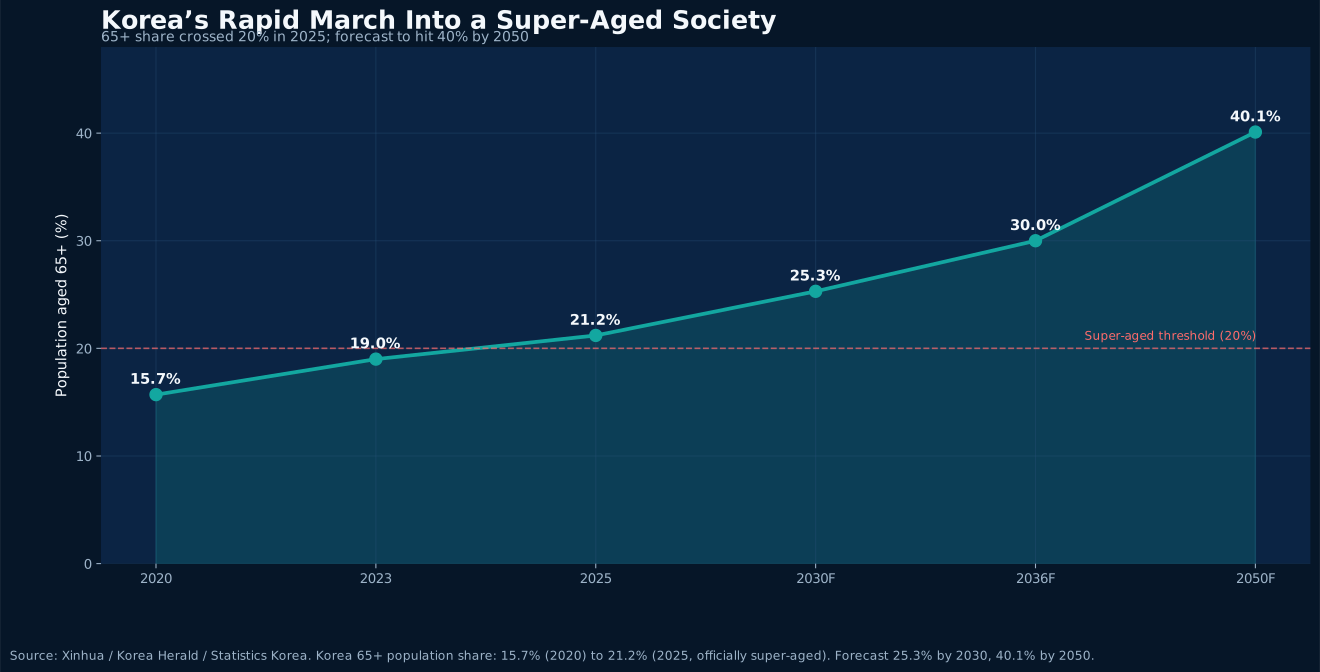
In September 2025, Statistics Korea reported that the 65+ population exceeded 10.84 million for the first time, reaching 21.21% of the total population and officially crossing the UN’s “super-aged society” threshold (20%). Korea went from an “aging society” (7%, 2000) to an “aged society” (14%, 2018) in 18 years, and from “aged” to “super-aged” in just 7—three years faster than Japan, setting a world record.
The deeper implication is that Korean society has not yet had time to fully prepare for aging. The old-age dependency ratio is projected to climb from 29.3 in 2025 to 47.7 in 2035 and 77.3 in 2050, meaning every 100 working-age people will need to support nearly 80 elderly individuals. Meanwhile, Korea’s elderly poverty rate stands at 37.6%, the highest among OECD countries. This demographic upheaval is creating a massive but underserved market—the core opportunity of the silver economy.
2. China’s silver economy: the growth path from 7 trillion to 30 trillion
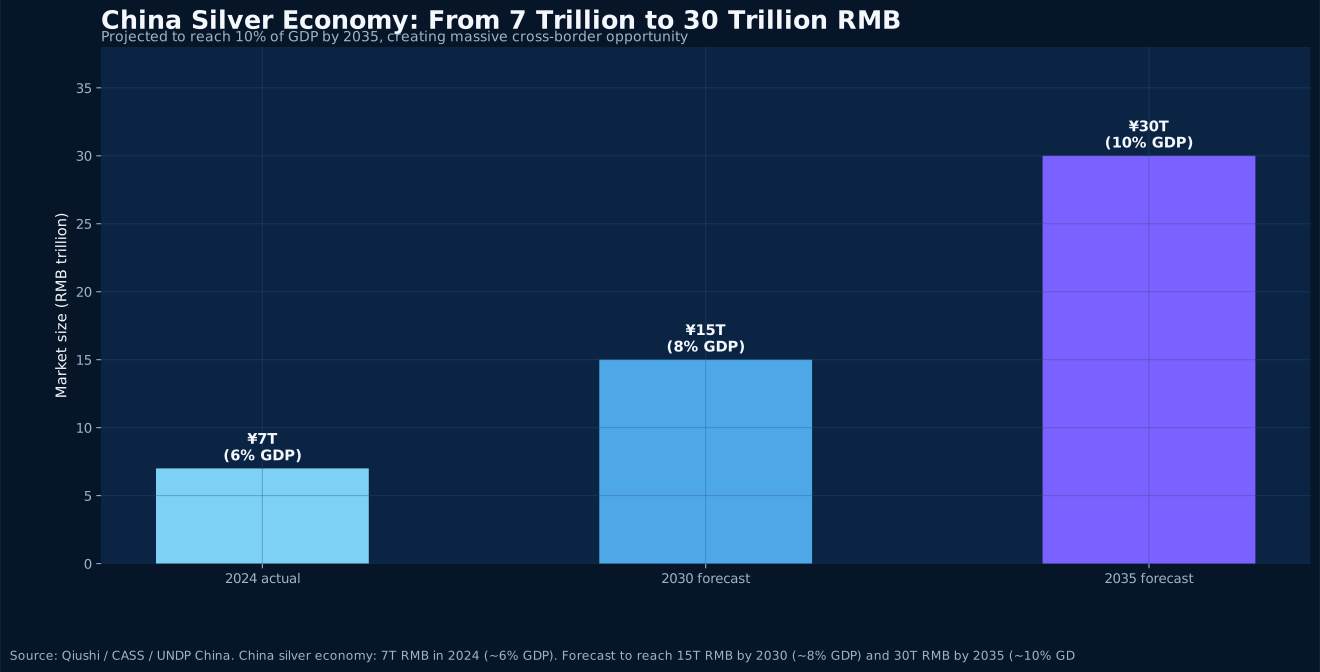
China’s aging is not as extreme as Korea’s, but the sheer population base makes its silver economy far larger in absolute terms. In 2024, China’s silver economy reached approximately 7 trillion RMB, about 6% of GDP. According to CASS and the Development Research Center of the State Council, this is projected to reach 15 trillion (8% of GDP) by 2030 and exceed 30 trillion (10% of GDP) by 2035.
China’s silver economy expansion is driven by multiple factors. In January 2025, the State Council issued the first national policy document titled with “silver economy,” outlining seven priority sectors including smart health eldercare, elderly products, rehabilitation aids, and senior finance. Liaoning hosted the first Northeast Asia Silver Economy Cooperation Exchange, attracting 407 enterprises, while Shanghai’s International Senior Care Expo drew over 500 exhibitors from 16 countries. The market is rapidly transitioning from concept stage to industrialization.
3. China-Korea complementarity: hardware design meets scaled deployment
China-Korea complementarity in the silver economy spans different links of the value chain. Korea leads Asia in smart elderly-care hardware—according to Korea’s Ministry of Trade, Industry and Energy, the smart eldercare tech market reached 12.7 trillion KRW (~$9.5B) in 2023. Samsung, LG, and SK have mature capabilities in health monitoring sensors, smart home systems, and rehabilitation robots. Korea also holds unique brand advantages in medical aesthetics, functional foods, and health management services across Asian markets.
China’s advantages lie in algorithm optimization, large-scale deployment capability, and cost control. China has accumulated rich experience in AI-assisted diagnostics, remote health management platforms, and smart community eldercare services, operating the world’s largest smart eldercare application landscape. Additionally, China maintains significant manufacturing cost advantages in rehabilitation aids, wheelchairs, and care beds. If the two countries deepen cooperation under a “Korean design + Chinese manufacturing + both markets” model, the silver economy could become the next pillar of China-Korea industrial cooperation after semiconductors and automobiles.
4. Cross-border trade opportunities: from elderly food to rehabilitation equipment
Cross-border trade opportunities in the silver economy cluster around several core categories. First is health functional food. Korea’s health functional food market is projected to reach 25 trillion KRW by 2030, but domestic capacity cannot keep up with rapidly growing demand. China holds cost and capacity advantages in red ginseng processing, plant extracts, and probiotic raw materials, with multiple Chinese ingredient suppliers already in Korean health food supply chains.
Second is rehabilitation aids and eldercare equipment. In Korea’s 2026 elderly care equipment market, imports exceed 40% and are rising annually. Chinese electric wheelchairs, smart care beds, and walking aids are competitive on value, especially as tariffs on these categories have dropped significantly under the China-Korea FTA and RCEP. Third is smart wearables and remote monitoring devices. Korean consumers are highly receptive to health management electronics, and China’s Shenzhen-Dongguan consumer electronics supply chain offers rapid customized production. Cross-border trade in these categories is expected to maintain double-digit growth over the next five years.
5. Policy support and frameworks: silver economy dividends from the China-Korea FTA
The China-Korea FTA and RCEP provide institutional support for cross-border silver economy cooperation. On goods trade, health food ingredients, rehabilitation equipment, and care products already benefit from tariff concessions, with some items at zero duty. On services trade, the China-Korea FTA Phase 2 negotiations are advancing cross-border services and investment negative list discussions, with eldercare and healthcare services listed as priority opening sectors.
At the local cooperation level, the 2026 Boao Forum for Asia established a dedicated aging sub-forum where Chinese, Korean, and Japanese experts discussed mutual recognition of smart eldercare technology standards, cross-border training for care workers, and innovation in senior financial products. China’s Ministry of Commerce in early 2026 explicitly placed the silver economy on the priority list for China-Korea emerging cooperation areas, alongside AI and green industry. This signals that the silver economy has been elevated from a social topic to a trade agenda, opening new business pathways for practitioners.
6. Outlook: the silver economy as the next growth pole in China-Korea trade
As Korea enters super-aged status at the world’s fastest pace and China’s silver economy expands from 7 trillion toward 30 trillion RMB, cooperation in this field is no longer a nice-to-have but an industrial inevitability. Korea’s design capability and brand influence paired with China’s manufacturing scale, algorithmic strength, and market depth form a natural complementary relationship. From smart nursing robots to functional elderly food, from remote health monitoring to age-friendly home renovation, every sub-segment holds cooperation potential.
For China-Korea trade practitioners, the silver economy offers a rare convergence of policy support, market demand, and technological complementarity. Companies that position early in this space—whether in raw material supply, finished goods manufacturing, or technology services—have the opportunity to capture first-mover advantage in the coming decade’s aging wave. The key is understanding Korea’s high standards for quality, compliance, and user experience while fully leveraging China’s core strengths in scale and cost optimization. The silver economy is not a niche market—it is becoming the next major arena for China-Korea trade.