1. From 15% to 25%: the US-Korea tariff roller coaster
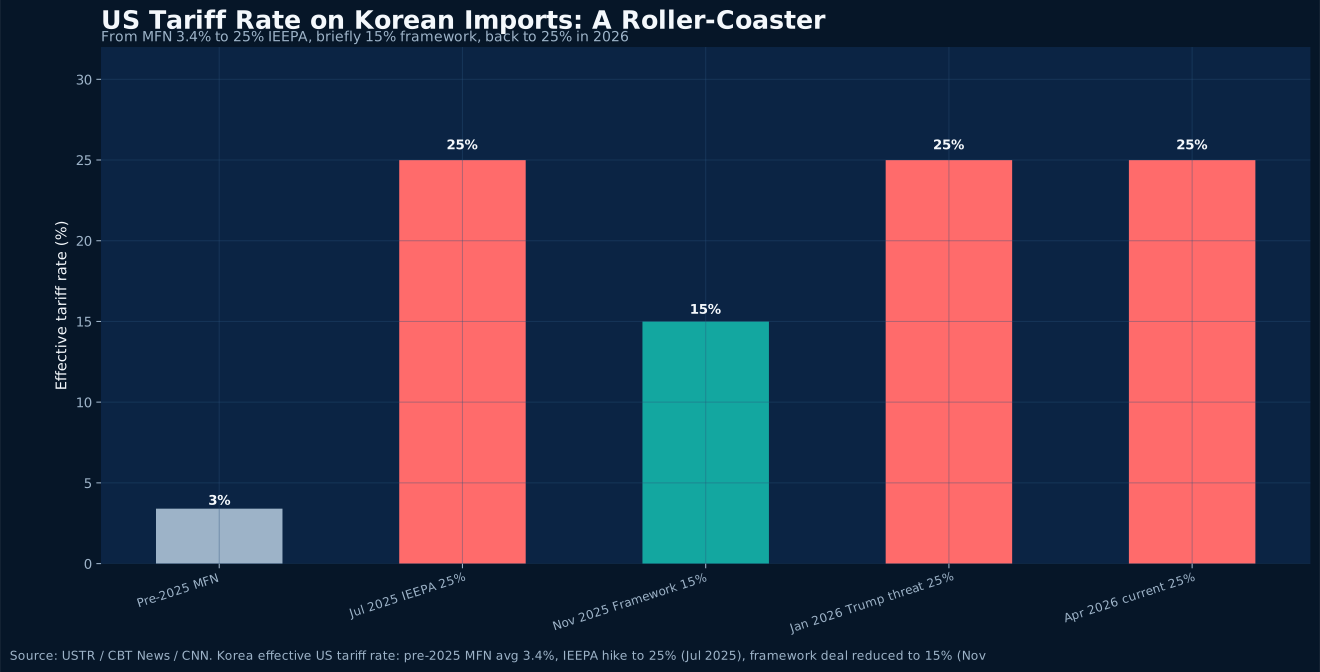
In July 2025, the Trump administration invoked the International Emergency Economic Powers Act (IEEPA) to impose 25% tariffs on Korean goods, covering core export categories including automobiles, auto parts, lumber, and derivatives. The backdrop was a widening US-Korea goods trade deficit—exceeding $66 billion in 2024, with automobiles and semiconductors as the two largest deficit drivers. Seoul launched rapid negotiations, and both sides reached a framework agreement by late July 2025 reducing the rate to 15%, formalized in November.
However, the framework deal included a Korean pledge to invest $350 billion in US strategic industries, requiring legislation through Korea’s National Assembly. Due to legislative delays, Trump announced on January 27, 2026 via social media that tariffs would be raised back to 25%. On March 12, 2026, Korea’s Assembly passed the Special Act on US Investment, but tariff rates have not yet reverted. As of April 2026, the 25% effective rate remains in force. This back-and-forth created unprecedented policy uncertainty for Korean exporters and directly accelerated the conglomerates’ dual-track investment strategy.
2. $800B domestic investment: conglomerates doubling down at home
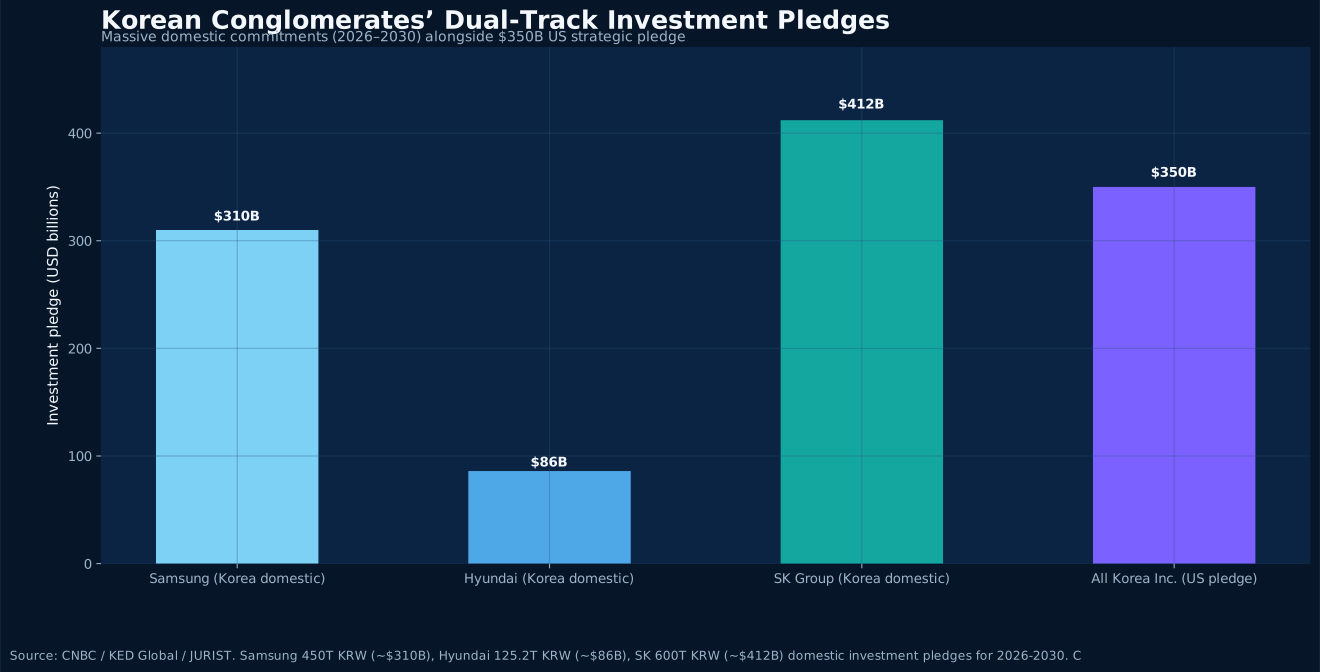
One direct effect of tariff pressure is an unprecedented surge in domestic investment by Korean conglomerates. Samsung Electronics pledged 450 trillion KRW (~$310B) for 2026–2030 in Korea, focused on the Pyeongtaek P5 semiconductor line and AI data centers outside Seoul. Hyundai Motor Group announced 125.2 trillion KRW (~$86B) in domestic investment targeting electrification, software-defined vehicles, and AI robotics. SK Group declared a record 600 trillion KRW (~$412B) domestic commitment.
These investments share a common theme: technology-intensive and supply-chain-autonomous. Samsung’s semiconductor expansion requires massive equipment and materials support; Hyundai’s EV transition needs complete battery, motor, and control system supply chains; SK’s battery and chip ambitions equally depend on upstream materials and equipment. This means that even though investment lands in Korea, demand for Chinese suppliers will not vanish—intermediate trade in equipment parts, chemical materials, and processed rare earths may actually increase as Korean domestic capacity expands.
3. $350B US pledge: tariff-driven industrial relocation
Running parallel to domestic investment is a $350B pledge to US strategic industries. Of this, $150B targets US shipbuilding, with another $200B covering semiconductors, batteries, and AI infrastructure. To prevent capital outflows from destabilizing domestic finances, Seoul capped annual US investment at $20B. Hyundai Motor Group has already announced a $21B US localization plan, including a $5.8B steel plant in Louisiana slated for Q3 2026 groundbreaking.
The US investment is essentially an exchange of capacity relocation for market access. Korean factories in the US can bypass tariff barriers and access subsidies under the Inflation Reduction Act. But building factories is not the same as breaking supply chains—US plants still need massive intermediate goods and components from Asia. Take Hyundai’s Louisiana steel plant: upstream iron ore, alloy materials, and specialty steel processing still largely depend on Chinese supply chains. This “final assembly in the US, intermediates in Asia” distributed production pattern is becoming the new normal under tariff pressure.
4. Structural shift: from finished-goods trade to embedded support
Tariff-driven dual-track investment is fundamentally changing how the China-Korea supply chain operates. Over the past decade, the typical pattern was “China exports raw materials and intermediates → Korea processes and assembles → exports to the US and global markets.” Now, with Korean firms expanding simultaneously at home and in the US, demand on Chinese suppliers is evolving from simple raw material procurement to customized support services.
Specifically, this change manifests on three levels. First, intermediate goods face higher specification demands—chemicals, sputtering targets, and specialty gases for Korean semiconductor and battery lines require purity and lead-time standards far beyond commodity trade. Second, technical service trade is growing—equipment installation, process calibration, and supply chain consulting exports are emerging growth areas. Third, compliance support needs are increasing—Korean factories in the US must meet rules of origin, ESG disclosure, and UFLPA requirements, meaning Chinese suppliers need to provide traceability documentation and certification support.
5. Opportunity windows and strategic adjustments for Chinese suppliers
For Chinese suppliers, China-Korea trade under 25% tariffs is not entirely bad news. Korean domestic expansion in semiconductors, batteries, and automotive needs massive equipment components, chemical feedstocks, and processed materials. China holds global cost and capacity advantages in chemical intermediates, processed rare earths, precision castings, and electronic materials. As long as products meet Korean firms’ increasingly demanding quality and delivery standards, intermediate goods trade still has substantial growth potential.
Even more noteworthy is the “indirect export” opportunity. Korean factories being built in the US will initially source equipment and raw materials largely from Asian supply chains. Chinese suppliers who can establish relationships through Korean intermediaries or directly with Korean firms’ US subsidiaries can participate in indirect US market supply. This requires stronger compliance capabilities, English technical documentation, and deep understanding of US trade rules. For export-oriented firms, upgrading from “China-Korea bilateral trade” to “China-Korea-US triangular supply chain” capability is becoming essential.
6. Outlook: tariff uncertainty will shape the new China-Korea trade paradigm for years
In the short term, the 25% tariff delivers a direct and significant blow to Korean auto, lumber, and pharmaceutical exports. But in the medium to long term, tariff pressure has paradoxically accelerated Korea’s industrial upgrading and investment rebalancing. The conglomerates’ dual-track strategy is not a temporary fix but a structural response—they are consolidating their technological base through domestic expansion while exchanging US investment for market access and policy protection.
For China-Korea trade practitioners, the most important mindset shift is this: the core value of the supply chain is moving from “price competitiveness” to “system support capability.” Over the next five years, Chinese suppliers who can deliver high-quality intermediates, technical services, and compliance support to Korean firms will be well-positioned in this tariff-driven supply chain restructuring. Those still operating under a “low price, high volume” mentality risk being gradually marginalized. This is not just a trade question—it is a strategic question about industrial upgrading.