1. China’s Global Dominance in Industrial Robots
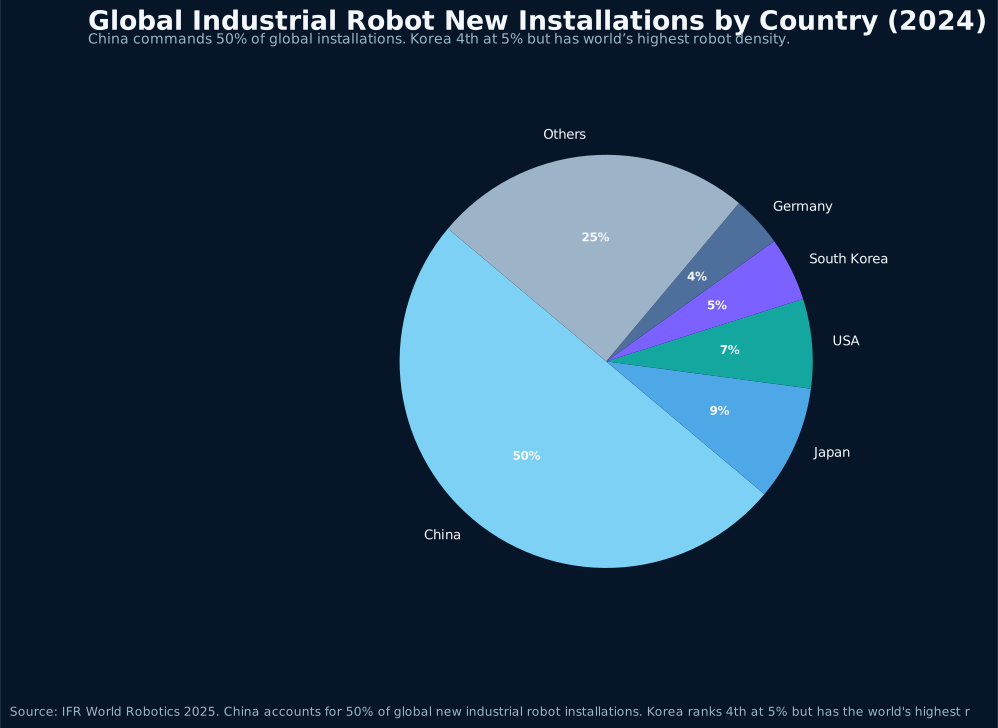
China has become the absolute leader in the global industrial robot market. According to the International Federation of Robotics (IFR), China accounts for 50% of all new industrial robot installations globally, far exceeding second-place Japan (9%), the United States (7%), and Korea (5%). China’s operational robot stock stands at approximately 2 million units—about 4.5 times that of second-place Japan. In the first half of 2025 alone, China’s industrial robot production surged 35.6% year-on-year, reaching nearly 370,000 units.
Behind this growth is strong government support for the robotics industry. In the newly released 15th Five-Year Plan, robotics is listed as a key element of the new economic growth model, with policy documents explicitly stating that China will invest massively in the robotics sector. In December 2025, China established a dedicated Humanoid Robot and Embodied Intelligence Standardization Technical Committee, and by March 2026 released the first national standard system covering the humanoid robot industry’s entire lifecycle.
2. Korea’s Global Lead in Robot Density
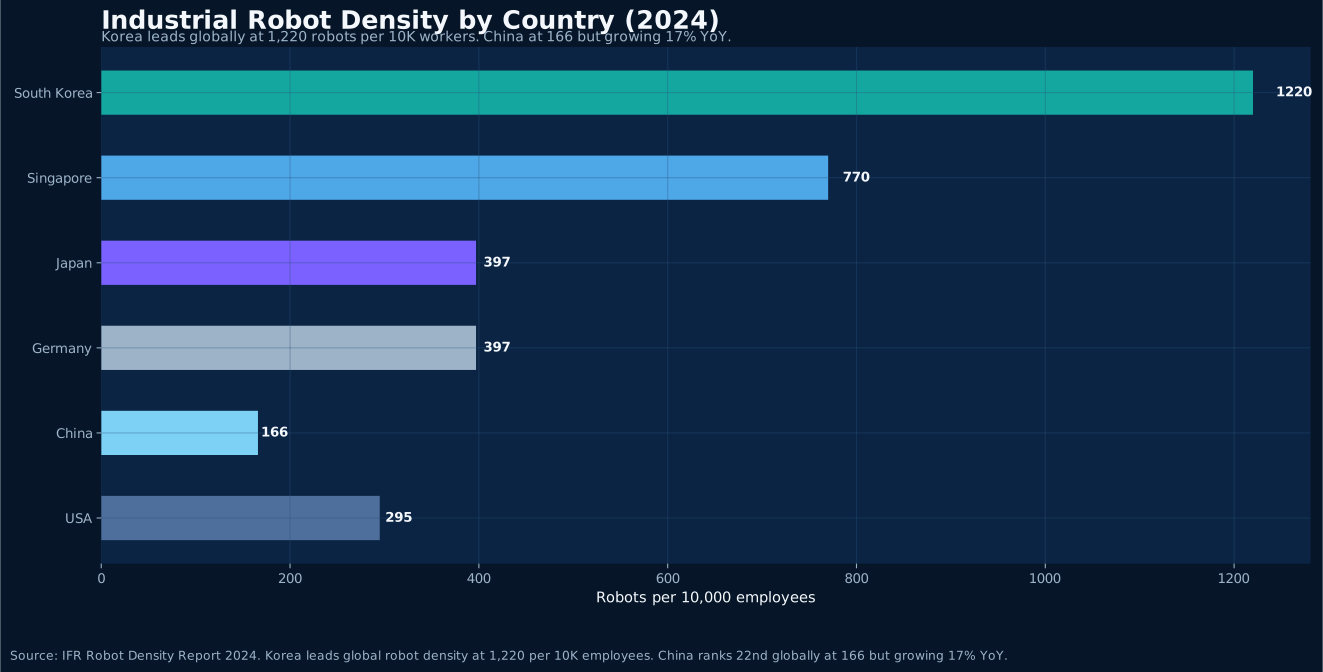
If China leads in robot quantity, Korea dominates in robot density. Korea’s industrial robot density stands at 1,220 robots per 10,000 manufacturing employees—the world’s highest—far exceeding Singapore (770), Japan (397), and Germany (397). By comparison, China’s robot density is only 166 per 10,000 workers, but its annual growth rate of 17% shows strong catch-up momentum.
Korea’s high robot density is primarily driven by its highly automated automotive, semiconductor, and electronics manufacturing sectors. Industry giants like Hyundai Motor, Samsung Electronics, and SK Hynix are major drivers of robot adoption. The Korean government has set a target of increasing factory automation rates by 10% by 2030, which will further expand robot market demand.
3. AW 2026: China’s Humanoid Robots Debut in Korea
The Smart Factory & Automation World (AW 2026) exhibition held at Seoul’s COEX in March 2026 became a major milestone in China-Korea robotics cooperation. 500 companies from 24 countries exhibited across 2,300 booths, setting a 36-year record. The most notable highlight was China’s Big Five humanoid robot makers—Agibot, Fourier, Huawei, Leju, and Unitree—appearing together in the Korean market for the first time.
This collective debut was not merely a technology showcase but a commercial signal of Chinese robot companies expanding into the Korean market. According to the Korea Association of AI Robot Industry, Chinese companies already hold over 70% of Korea’s service robot market, and 54% of the robot vacuum cleaner market. Now, Chinese companies are expanding from service robots into more advanced humanoid robots and exoskeletons.
4. The Complementary Structure of China-Korea Robotics
China and Korea exhibit strong complementarity in the robotics industry. China’s advantages lie in market scale, production costs, and rapid iteration capabilities, enabling large-scale robot production at lower costs. Korea’s advantages are in advanced automation integration experience, precision manufacturing technology, and application validation in high-end manufacturing fields like semiconductors and automotive.
This complementary structure provides broad space for cooperation. For example, Korean companies can leverage China’s supply chain advantages to reduce robot component costs, while Chinese companies can learn from Korea’s expertise in high-precision assembly and system integration. In the humanoid robot field, China leads in hardware manufacturing and cost control, while Korea has technological advantages in certain key sensors and control algorithms.
5. The New Arena of Humanoid Robots and AI Integration
2026 is a breakthrough year for the humanoid robot industry. The global humanoid robot market is projected to grow from USD 2.92 billion in 2025 to USD 15.26 billion by 2030, with a CAGR of 39.2%. China’s market is expected to reach USD 1.41 billion in 2026. The deep integration of humanoid robots with AI large models is opening broad application scenarios from industrial assembly and logistics delivery to elderly care services.
China has established a clear early advantage in humanoid robots. By 2025 shipments, the top six global humanoid robot manufacturers were all from China, including Agibot, Unitree, UBTech, Leju Robotics, Engine AI, and Fourier Intelligence. Korea has unique advantages in humanoid robot application scenarios and commercialization, particularly in areas closely aligned with its aging society needs, such as elderly care and healthcare.
6. Future Outlook for China-Korea Robotics Cooperation
China-Korea robotics cooperation is entering a new chapter. In traditional industrial robotics, supply chain cooperation between the two countries is already quite mature, with China supplying large quantities of robot components and integrated assemblies for Korean manufacturing. Future cooperation will extend further into humanoid robots, AI-integrated applications, and smart factory solutions.
For China-Korea trade enterprises, the rapid development of the robotics industry represents enormous commercial opportunities. From cross-border supply chains for robot components, to joint exports of smart manufacturing solutions, to co-development of humanoid robot application scenarios, China-Korea robotics cooperation is opening entirely new growth spaces for bilateral trade. As an international trade firm familiar with both countries’ industrial ecosystems, MO-TEK will continue to monitor the latest developments in the robotics industry and help clients seize commercial opportunities in this wave.