From Science to Industry: DAC's Commercial Moment
The principle of direct air capture (DAC) is not complex: use chemical sorbents or solvents to separate carbon dioxide directly from the atmosphere, then compress and store it or use it industrially. The difficulty has never been the principle but cost and scale — capturing a tonne of carbon from thin air (CO₂ concentration only ~0.04%) demands far more energy and capital than capturing it from flue gas. That is why DAC has long been seen as “right but expensive.”
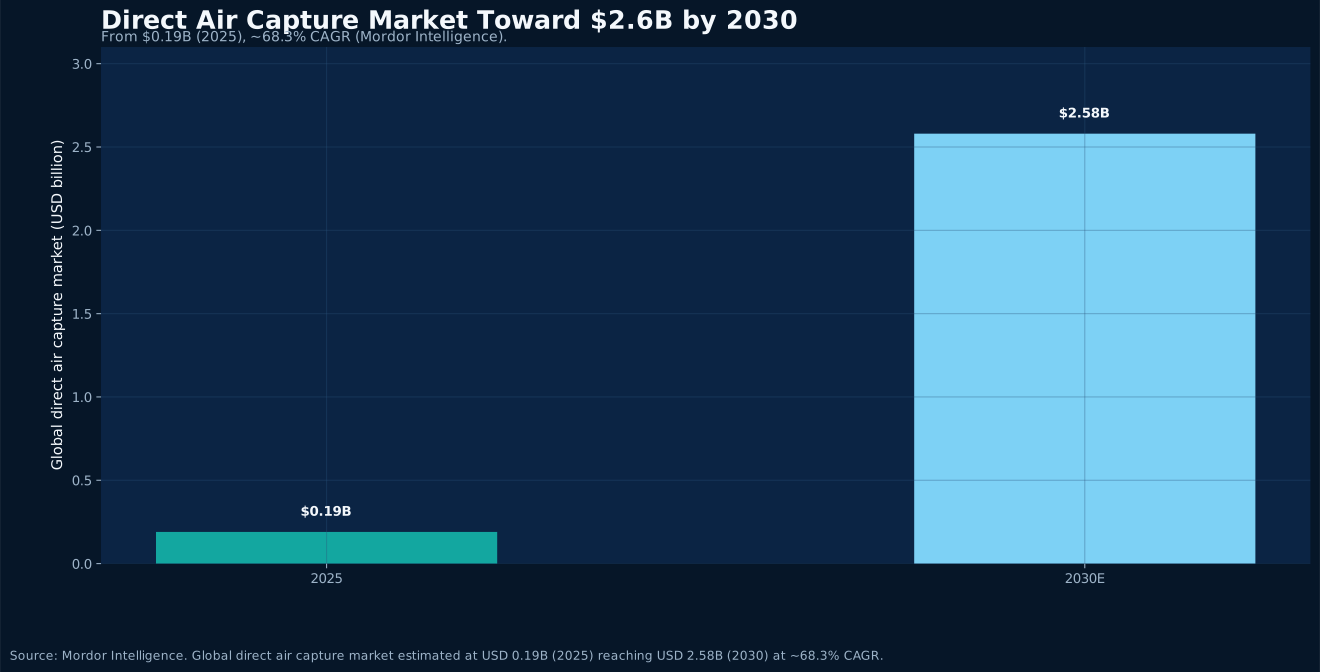
But the signals in 2026 show the inflection is near. Per Mordor Intelligence, the global DAC market will grow from ~$0.19B in 2025 to ~$2.58B in 2030 — more than a twelvefold rise in five years at a CAGR above 68%. Behind this explosive growth are a maturing carbon-credit market, arriving policy subsidies, and long-term offtake agreements signed by tech giants to counter data-center emissions.
The Pipeline Ramps: From 50 Mt to 430 Mt
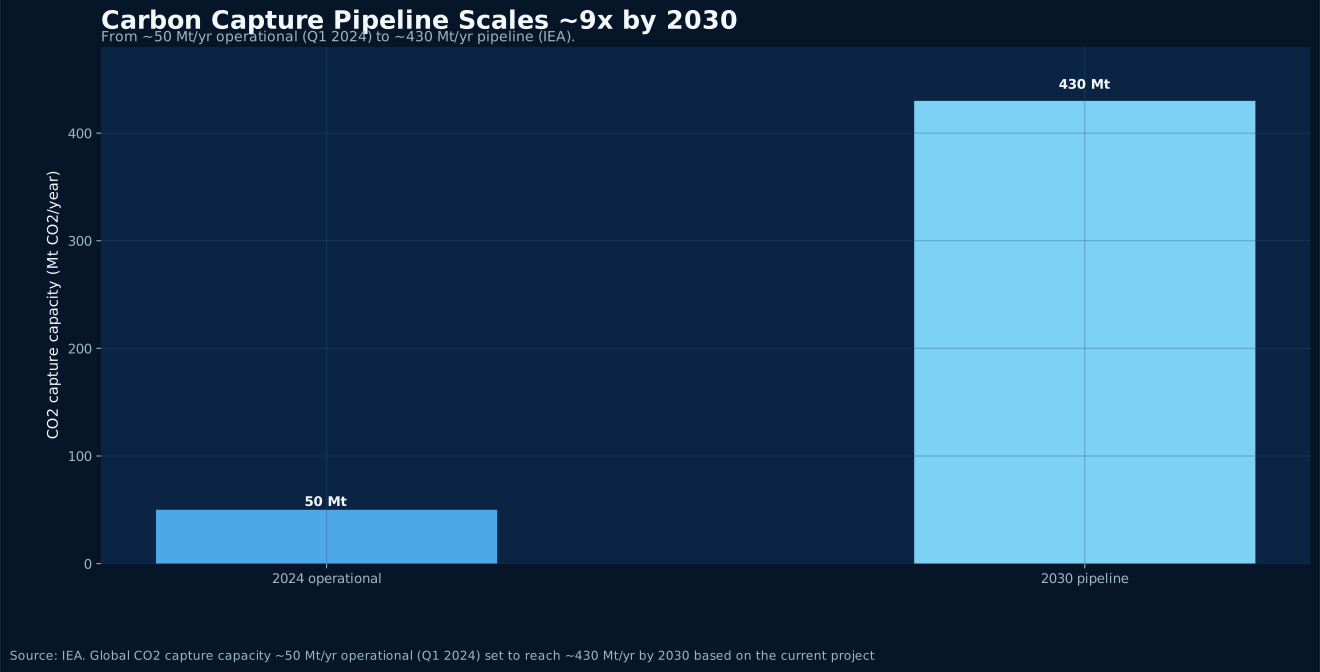
If market size reflects value, the capacity pipeline reflects the pace of physical deployment. Per the IEA, as of early 2024 the world had about 50 Mt/yr of operating CO₂ capture capacity (across all applications); based on the current pipeline of projects under construction and planned, that could climb to about 430 Mt/yr by 2030 — roughly nine times today's level. It is a steep curve from demonstration to industrialization.
Zooming into DAC itself, the IEA notes about 27 DAC plants are operational worldwide, but most are small demonstrations; only a handful capture over a thousand tonnes a year, such as Climeworks' plant in Iceland and facilities in Colorado and California. More importantly, at least 130 large-scale (>1,000 t/yr) DAC projects are now at various stages of development; if all were realized, they would approach the ~65 Mt/yr needed in 2030 under the Net Zero scenario.
The Cost Curve: The Make-or-Break Variable
Whether DAC truly scales ultimately depends on whether the cost per tonne captured can fall. Today's first-generation DAC costs on the order of several hundred dollars per tonne — far above natural sinks or point-source capture. To make DAC commercially sustainable, the industry broadly agrees costs must be pushed below $100 per tonne, requiring cheaper clean power, more efficient sorbents, and scale effects that spread equipment and O&M costs.
This also explains why DAC is increasingly tied to clean energy and even AI data centers: big tech firms are both major emitters and huge buyers of clean power, and by folding DAC procurement into their net-zero roadmaps they provide steady demand and underwrite project financing. Only when the economics of “capturing a tonne” roughly balance will the flywheel of scale truly begin to turn.
China–Korea View: New Opportunities in the Clean-Tech Supply Chain
For China–Korea industry, DAC scale-up means a new supply chain is taking shape: from sorbent materials, modular fans and heat exchangers, to the full kit for compression, transport and storage, there are opportunities for localization and export. China's cost advantage in clean-energy equipment manufacturing and Korea's strengths in precision chemical materials and EPC are naturally complementary.
MO-TEK observes that as the EU's Carbon Border Adjustment Mechanism (CBAM) and national carbon markets tighten, export-oriented manufacturers' demand for verifiable carbon credits is rising. As a durable, easily verified form of removal, DAC could become part of exporters' carbon-compliance portfolios. Positioning early in related equipment and materials supply is a pragmatic path to turning climate policy into trade opportunity.
Risks and a Pragmatic Read
It must be seen clearly that DAC still faces real uncertainty: cost declines may come slower than hoped, carbon-credit price swings directly affect project returns, and the durability of subsidies depends on national fiscal and political cycles. Historically many “clean-tech waves” went through overheating and shakeout; DAC likewise warrants cautious optimism rather than blind enthusiasm.
But the direction is clear: with net zero now a global consensus, carbon removal is not optional but mandatory. For trade and manufacturing firms, rather than passively awaiting rising carbon costs, it is better to proactively understand this emerging supply chain and find entry points matched to one's capabilities across equipment, materials and carbon credits. In the decade of scale-up, the opportunities belong to those who do their homework early.
Outlook: Turning Climate Pledges into Industrial Reality
For years carbon removal stayed mostly at the pledge and research stage; but 2026's market and capacity data show it is accelerating into real engineering and manufacturing. From mass-producing sorbents, to standardizing modular capture units, to siting storage and building pipeline infrastructure, DAC is replaying the “demonstration-to-scale” path that wind and solar once took. Once scale effects kick in, falling costs and faster deployment reinforce each other in a virtuous cycle.
For China–Korea manufacturing and trade firms, now is the window to understand and position along this supply chain. Whether supplying equipment such as fans, heat exchangers and compressors, participating in sorbent materials, corrosion-resistant piping and monitoring sensors, or folding verifiable carbon credits into an export-compliance portfolio, there is room to explore. MO-TEK advises clients to engage at a steady “understand first, then enter” pace: first map project needs and compliance thresholds, then choose the links best matched to their capacity and materials strengths, turning a long-term climate trend into sustainable trade opportunity.