The KC Mark: Korea's Unified Safety System Born From 140 Separate Marks
In 2009, the Korean government consolidated 140 separate certification marks — previously administered by 13 different ministries — into a single KC (Korea Certification) mark, completing full implementation by November 2011. This integration was led by the Korean Agency for Technology and Standards (KATS), operating under the Ministry of Trade, Industry and Energy (MOTIE). The KC mark covers 250 product types under the Electrical Appliances and Living Products Safety Management Act — 173 electrical and 77 daily-use products — while children's products are separately governed by the Children's Product Safety Special Act. Including automotive parts, industrial equipment, and other programs, the KC mark effectively covers approximately 730 product types.
KC certification is divided into three main tiers: Safety Certification (안전인증) targets the highest-risk products (50 types), requiring factory audits and annual follow-up inspections; Safety Confirmation (안전확인) covers medium-risk products (92 types) with product testing only; and Supplier Conformity Confirmation (공급자적합성확인) covers lower-risk products (85 types) through self-declaration. An additional 23 daily-use products fall under Safety Standards Compliance. For Chinese exporters, understanding which tier applies to their product is the critical first step for Korean market entry.
The Compliance Gap: Why Overseas E-Commerce Products Fail at Higher Rates
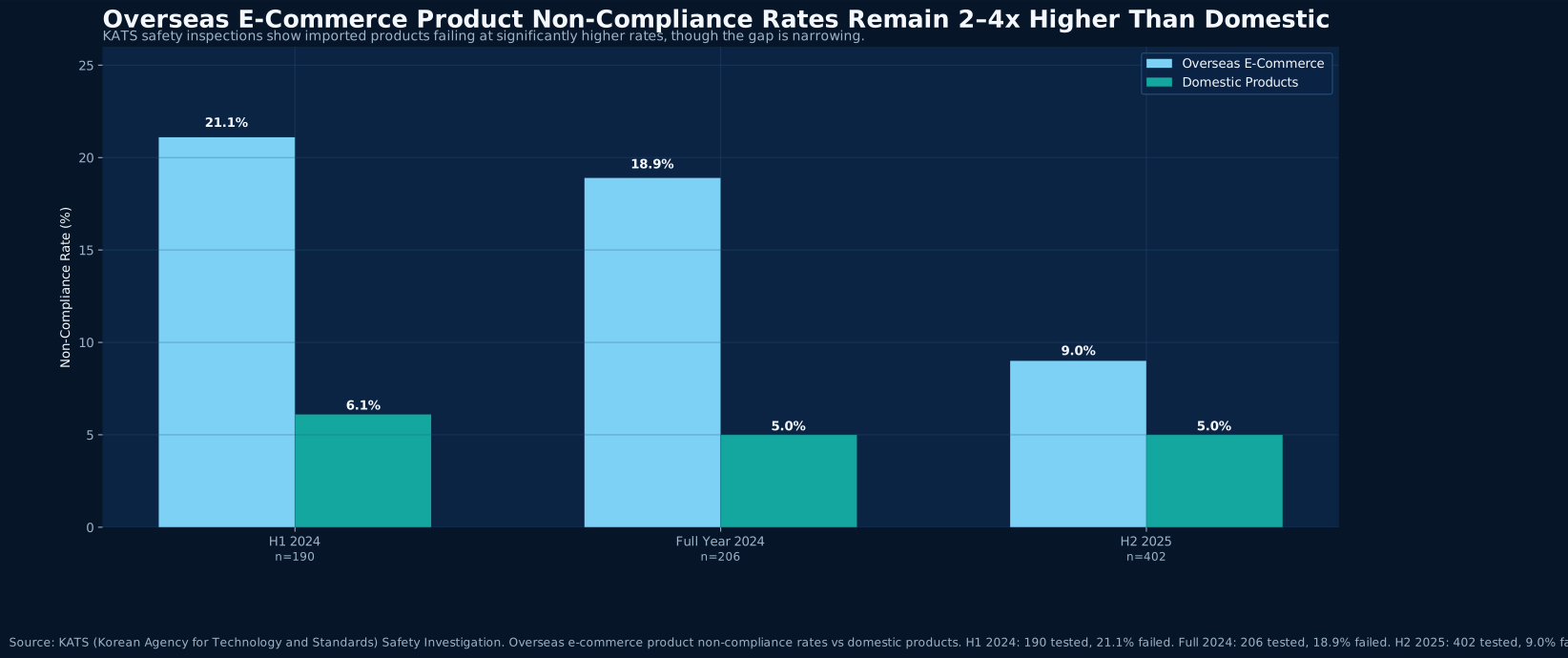
KATS safety investigation data reveals a significant compliance gap. In H1 2024, inspections of 190 overseas e-commerce products found a non-compliance rate of 21.1% — versus just 6.1% for domestic products, a gap of nearly 3.5x. For all of 2024, 39 of 206 tested products failed (18.9%). Notably, by H2 2025, with inspection scale doubled to 402 products, the non-compliance rate had dropped to 9.0%, narrowing the gap with domestic products (~5%) to approximately 1.8x.
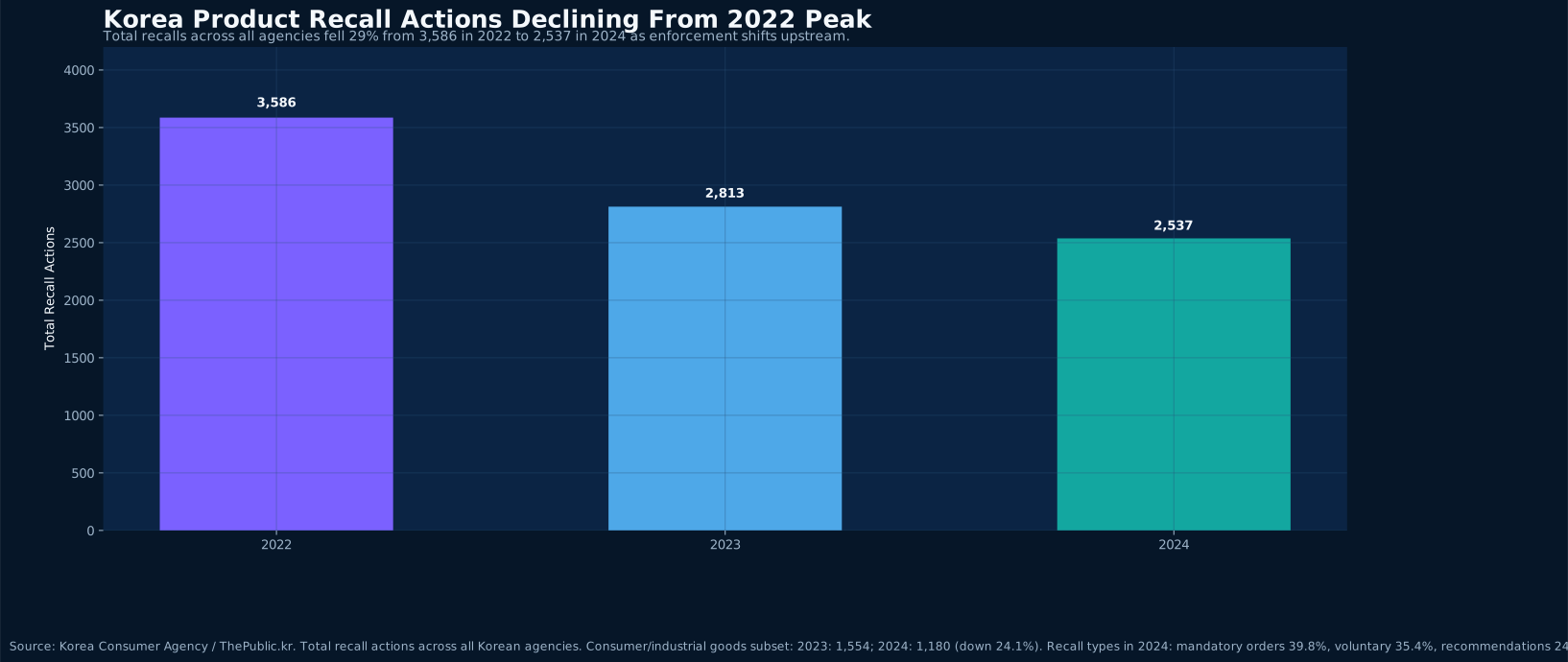
Specific non-compliance cases are alarming. KATS enforcement has found children's products with phthalate levels 270–500x above limits, chargers reaching 130°C (limit: 110°C), and seat cushions hitting 91°C (limit: 85°C). Meanwhile, Korea Customs Service data shows that from 2022 to July 2024, customs rejections from Chinese direct-purchase platforms exceeded 634,000 cases. While total multi-agency recall actions declined from a 2022 peak of 3,586 to 2,537 in 2024, the consumer/industrial goods subset still recorded 1,180 cases in 2024.
Certification Process, Costs, and Timelines
For Chinese exporters, the KC certification process typically includes: product classification and tier determination → selection of a KATS-accredited testing laboratory → product testing → factory audit (if Safety Certification tier) → certificate issuance → KC mark labeling. Costs vary dramatically by product type: home appliances and lighting $700–$2,800; industrial equipment $2,100–$4,200; children's products and toys $1,100–$3,500; wireless devices up to $2,800–$18,000. Factory audit fees are additional: initial audit $280–$1,400, annual follow-up $560–$900. A Korean local agent is also required ($700–$2,100).
In terms of timelines, Safety Certification (with factory audit) typically takes 4–5 months, Safety Confirmation around 3–4 months, and Supplier Conformity around 2–3 months. An expedited path can compress this to 4–6 weeks. A key cost-reduction strategy is leveraging IEC CB certificates: China's CQC and Korea's KTL/KTC/KTR signed a mutual recognition agreement in 2016, allowing CB certificate holders to skip 30–50% of test items, significantly shortening the certification cycle. KATS's standard processing time is 45 days per application, extendable if testing exceeds 30 days.
E-Commerce Platform Enforcement and 2025-2026 Regulatory Changes
Korea's product safety enforcement focus is visibly shifting toward e-commerce platforms. In 2025, over 70% of product safety inspection resources were allocated to online channels. Coupang, Korea's largest e-commerce platform (~$30 billion GMV in 2024), now mandates KC certification for Chinese sellers' children's and electronic products. Gmarket and Alibaba International formed a $4 billion joint venture (Grand Opus Holdings) in December 2024, further facilitating Chinese product penetration of Korean e-commerce channels — while simultaneously bringing more Chinese sellers under Korean safety regulatory scrutiny. In May 2024, the government briefly announced a ban on 80 product categories lacking KC marks on e-commerce platforms; while retracted after three days due to business pushback, the signal was unmistakable.
Regulatory changes in 2025–2026 are intensifying: 23 product categories are undergoing safety standard revisions; smart/IoT devices must now submit cybersecurity compliance declarations; lithium battery products require RoHS test reports; the KC certification numbering system is being overhauled for traceability; and Korean-language label minimum font height has been raised to 5mm. Overseas e-commerce product inspections have doubled from 450 to 1,000+, and eight major e-commerce platforms are now required to push recall notifications directly to consumers. Penalties include fines up to KRW 75 million (~$56,000) and imprisonment up to 3 years plus KRW 30 million.
Practical Advice for Chinese Exporters and the Market Opportunity
For Chinese consumer goods exporters planning Korean market entry, several practical points deserve attention: First, start certification early — begin at least 6 months before planned market entry, with Safety Certification products requiring even longer lead times. Second, leverage CB certificates for cost reduction — if your company holds a CQC-issued CB certificate, it can exempt 30–50% of test items at Korean laboratories. Third, prioritize children's products and electronics, the two categories facing the highest KATS enforcement priority. Fourth, monitor the KATS priority product list annually (58 types in 2025) and assess whether your products are included.
At the same time, compliance itself is a competitive advantage. Korean consumers spent $3.1 billion on Chinese platforms in 2024 (+84% YoY), with China accounting for 62% of Korean overseas direct purchases. Coupang's opening to Chinese sellers and the Gmarket-Alibaba $4 billion JV mean that channel access barriers are lowering — but safety compliance barriers are rising. In this diverging dynamic, Chinese companies that secure and maintain KC certification first will gain significant first-mover advantages in the Korean market. A typical certification investment of $2,000–$10,000 buys legitimate entry to a consumer market with over $100 billion in annual e-commerce volume.