1. Visa-Free Policies Open New Channels for Two-Way Tourist Flows
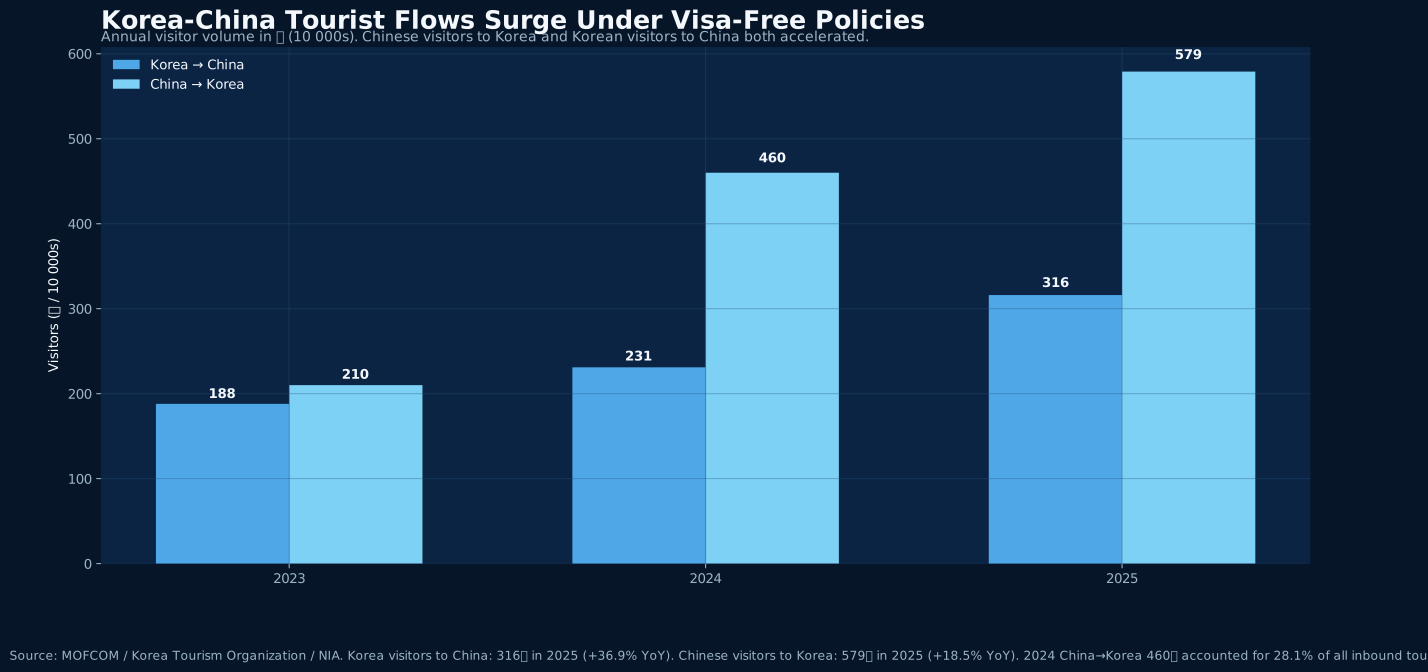
Since China introduced visa-free entry for Korean citizens in November 2024, people-to-people exchanges between the two countries have entered a new acceleration phase. In 2025, Korean visitors to China reached 3.16 million, a 36.9% year-on-year increase and a post-pandemic high. Meanwhile, Chinese visitors to Korea continued to climb, reaching 5.79 million for the full year, up 18.5% YoY and accounting for over 28% of all inbound foreign tourists. This means more than one in every four inbound visitors to Korea comes from China, cementing its position as Korea's top source market.
Entering 2026, this trend is not slowing but accelerating. In January 2026, approximately 303,000 Koreans visited China, a 48.1% YoY surge. Among young Koreans, a new consumption trend has emerged — flying to Shanghai, Qingdao, or Dalian right after work on Friday for a weekend getaway. Shanghai's figures are particularly striking: in the first half of 2025, about 424,000 Korean tourists visited the city, up 130.7% YoY. The visa-free policy has done more than lower the visa barrier; it has fundamentally changed the time dimension of travel decisions, making spontaneous trips possible.
2. The Deep Structural Shift in Chinese Tourist Spending in Korea
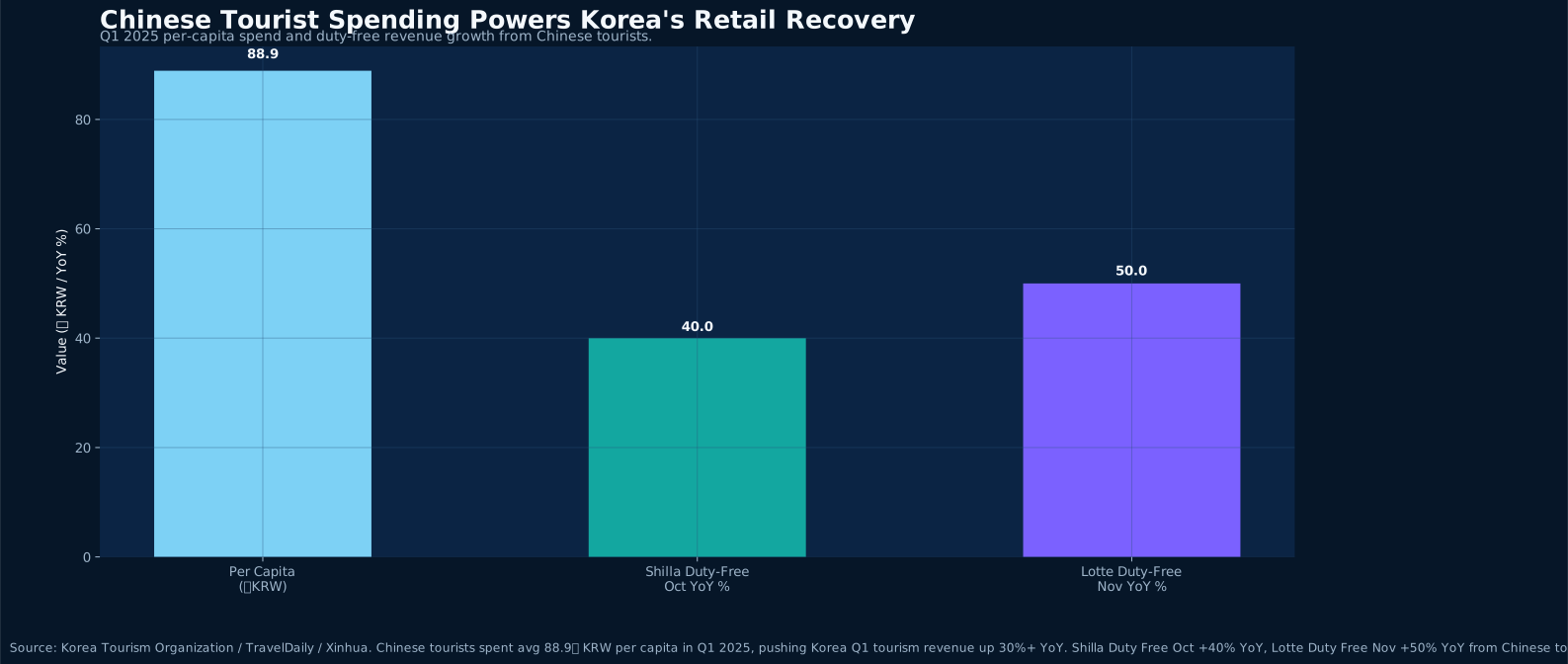
In aggregate terms, Chinese tourists remain the largest engine of tourism spending in Korea. In Q1 2025, Chinese tourists spent an average of 889,000 KRW per capita, directly pushing Korea's quarterly tourism revenue up by over 30% YoY. The duty-free channel recovery has been particularly notable: Shilla Duty Free saw Chinese tourist spending surge 40% YoY in October 2025, while Lotte Duty Free recorded a 50% YoY increase in November. This demonstrates that Chinese purchasing power has not disappeared — it has simply shifted toward different channels and categories.
At the same time, however, per-capita duty-free spending has actually declined — from 686,000 KRW to 535,000 KRW in the first half of 2024. Behind this seemingly contradictory phenomenon lies a fundamental shift in consumption structure. The pre-pandemic model of high-ticket group-tour purchasing is being replaced by individual free-travel experience-led consumption. More Chinese tourists visit Korea not to go on shopping sprees but to check in at trending restaurants, experience Korean culture, and create social media content. This shift demands entirely new product mixes and marketing strategies from Korea's retail sector.
3. Air Capacity Recovery and Route Expansion Accelerate Two-Way Flows
Behind the explosive growth in tourist flows, air capacity recovery provides essential infrastructure support. Korean airlines began significantly expanding China-Korea routes in the second half of 2025, with several carriers proactively positioning for the 2026 China market. Flight frequency on popular routes such as Incheon-Shanghai, Incheon-Beijing, and Incheon-Qingdao has approached or even exceeded pre-pandemic levels. The entry of low-cost carriers has further lowered the travel threshold, making weekend getaways financially viable.
Notably, route recovery is not limited to traditional tier-one city pairs. Direct flights between Korean cities and Chinese tier-two destinations such as Chengdu, Hangzhou, and Xi'an are also recovering rapidly, offering Korean travelers more diversified destination options and bringing fresh inbound tourism increments to China's second- and third-tier cities. From a trade perspective, the density of people-to-people travel directly affects the efficiency of business inspections, procurement matchmaking, and supply-chain coordination. Tourism route recovery is effectively paving more convenient channels for commercial exchange.
4. The Demonstration Effect of Korea's Group Tourist Visa-Free Policy
On September 29, 2025, Korea implemented a temporary visa-free entry policy for Chinese group tourists, valid through June 30, 2026. This policy marks a new phase in China-Korea tourism facilitation. Although still classified as a temporary arrangement, the strategic intent is clear: Korea aims to reactivate the Chinese group-tour market disrupted by the pandemic, particularly restoring tourism distribution capacity to regional Korean cities beyond Jeju Island.
Early data feedback shows the visa-free policy is gradually delivering results. During China's National Day Golden Week in 2025, Korean-bound travel orders from Chinese tourists grew significantly YoY, with Korea's retail, accommodation, and dining sectors all visibly benefiting. More importantly, the policy has created a demonstration effect — if tourism economic data remains positive during the temporary visa-free period, Korea is likely to convert it into a permanent arrangement. For businesses engaged in China-Korea trade, deepening tourism facilitation means commercial friction costs are simultaneously declining, which is particularly important for procurement and supply-chain management activities requiring frequent face-to-face communication.
5. How Tourism Dividends Translate into Trade Momentum
The impact of tourism recovery on China-Korea trade extends far beyond tourism revenue itself. In direct terms, Chinese tourist spending in Korea spans retail, dining, accommodation, transport, and cultural experiences, with 4.6 million Chinese visitors in 2024 contributing a record 879.53 billion KRW. In indirect terms, the increased density of tourism exchanges is creating more touchpoints for commercial cooperation — Korean buyers are visiting China more frequently for on-site inspections, while Chinese suppliers are deepening their understanding of the Korean market.
For businesses engaged in China-Korea trade, several signals deserve attention at this stage. First, the Korean government is actively promoting the integration of cultural tourism and commercial trade, with multiple local governments embedding industry matchmaking content into tourism promotions. Second, the recovery of air routes between Chinese tier-two cities and Korea means supply-chain matchmaking is no longer limited to the Seoul-Shanghai corridor — procurement networks are expanding to a wider geographic footprint. Third, the continued deepening of visa-free policies provides institutional support for frequent business travel, reducing the time cost and administrative friction of cross-border procurement. These trends are converging to create a lower-friction, higher-frequency collaboration environment for China-Korea trade.
6. Outlook: The Inflection Point from Recovery to Upgrade
The China-Korea tourism market is transitioning from the post-pandemic recovery phase into a structural upgrade phase. On one hand, tourist consumption behavior is shifting from shopping-centric to experience-diversified, raising the bar for destination product design and service support. On the other hand, continued tourism facilitation is lowering the institutional cost of cross-border mobility, increasingly blurring the line between business and leisure travel. For trade practitioners, this trend of tourism-trade convergence means customer development, market research, and supply-chain management can be more naturally integrated with travel activities.
Looking ahead to the second half of 2026 and beyond, if Korea converts the temporary group-tourist visa-free arrangement to a permanent one, China-Korea two-way tourism surpassing 15 million visitors will be only a matter of time. For MO-TEK International Trade and similar China-Korea trade service firms, the sustained release of tourism dividends is not just a macro tailwind but a micro-operational convenience — denser flight schedules, lower visa thresholds, and more frequent face-to-face contact are all creating more favorable conditions for supply-chain collaboration. Author: Minghao, MO-TEK International Trade (Shanghai)