1. The Data Speaks: Why C-Beauty Exports to Korea Suddenly Exploded
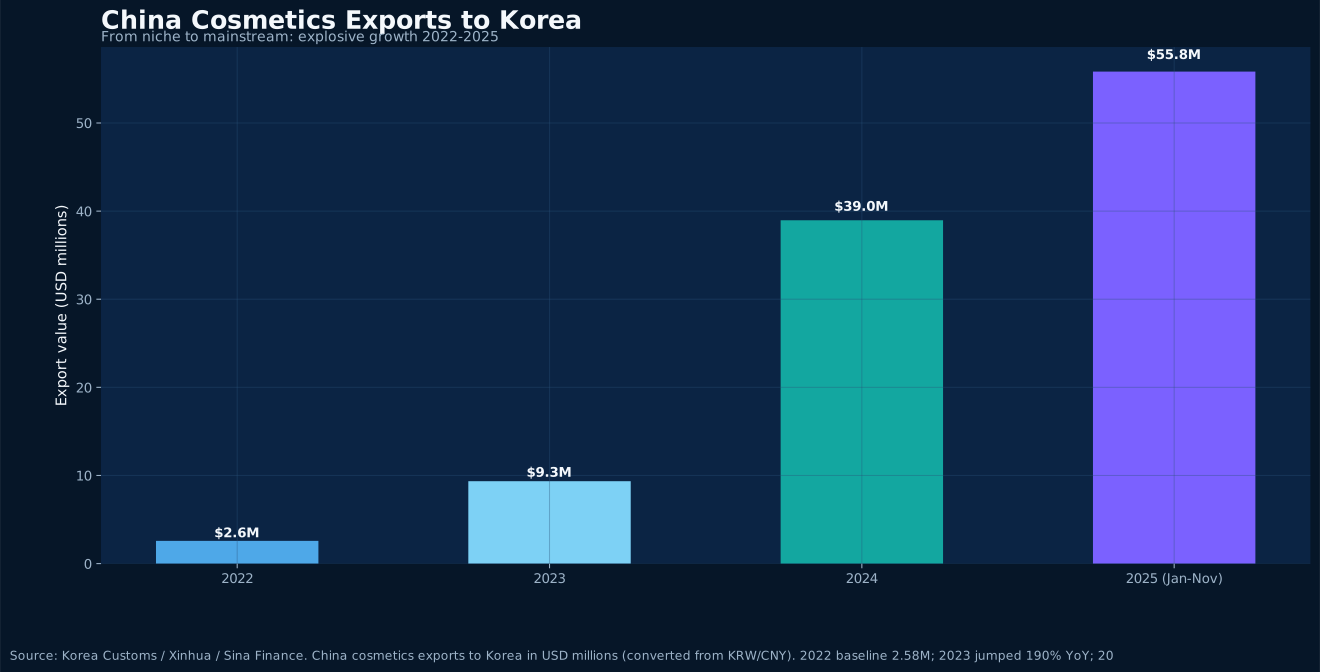
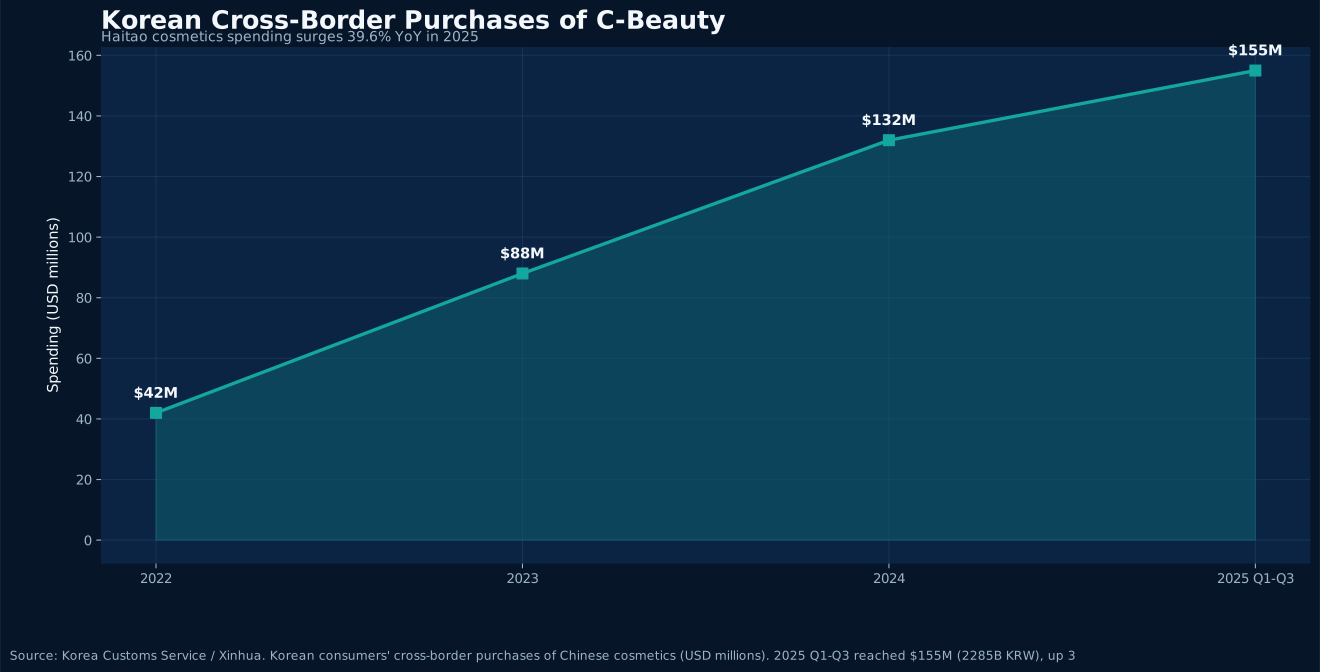
Tracing the data curve of Chinese cosmetics exports to Korea, the figure in 2022 was just $2.58 million — essentially negligible. But in 2023 it surged to $9.35 million (CNY basis), a 190%+ YoY jump that shocked the Korean beauty industry. By 2024, exports climbed further to $38.96 million. And in the first 11 months of 2025, the figure reached $55.83 million, meaning the full year will far exceed 2024. Over 20x growth in four years — a rare acceleration in any category of China-Korea trade. Meanwhile, Korean consumers' cross-border purchases of Chinese cosmetics also grew exponentially: Q1-Q3 2025 reached KRW 228.5 billion (~$155 million), up 39.6% YoY, a record high.
What drives this explosive growth? First, substantive improvement in product quality. Chinese cosmetics were long perceived in Korea as 'cheap substitutes,' but this has fundamentally changed. More Chinese brands are hiring Korean R&D personnel, with some even establishing R&D centers in Seoul. Simultaneously, Chinese brands are extensively using top Korean ODM companies (like Cosmax and Kolmar Korea) for manufacturing, ensuring products meet Korean consumer standards. Second, social media's crossover effect — TikTok and Xiaohongshu's global operations enable Korean young consumers to 'see' real usage effects of Chinese beauty products for the first time, rather than relying on traditional brand awareness channels.
2. From 'Value' to 'Product Power': The Upgrade Path of Chinese Beauty Brands
The first phase of Chinese beauty brands entering Korea indeed relied on price advantage. Color cosmetics (especially lip glazes and eyeshadow palettes) at one-third or even one-quarter the price of Korean equivalents attracted many 'trial' consumers. But price-driven growth has a natural ceiling — once curiosity fades, brands without product-power support are quickly forgotten. Therefore, a key trend since 2024 is Chinese brands transitioning from 'value' to 'product power.' This transformation manifests in three areas: first, R&D localization — establishing labs in Korea or partnering with Korean research institutions to optimize formulas for Korean consumers' skin characteristics and usage habits; second, ingredient storytelling upgrade — Chinese brands are incorporating differentiated concepts like traditional Chinese herbs and Eastern aesthetics into product narratives, forming brand distinctiveness different from K-beauty; third, packaging design improvement — from early 'copycat' aesthetics to increasingly involving Korean design teams in product appearance.
Xinhua's October 2025 feature reported that 'Chinese speed' is reshaping Korean beauty's 'second growth curve.' This assessment is not exaggerated. From a value chain perspective, Chinese brands entering Korea bring not just consumer-end competition but create new cooperation models on the supply side. Korean ODM companies have found that order growth from Chinese brands already exceeds that from traditional European, American, and Japanese clients. Leading ODMs like Cosmax are creating dedicated production lines and rapid prototyping channels for Chinese brands, which in turn drives Korean ODM industry capacity upgrades. This 'Chinese brand + Korean manufacturing' hybrid model is becoming the new paradigm of China-Korea beauty trade.
3. Gen Z Breaks Barriers: How Social Media Dissolves 'Country-of-Origin Bias'
A key catalyst for C-beauty's rise in Korea is social media. In traditional retail channels, brand awareness heavily depends on advertising and shelf placement — the moat K-beauty brands meticulously built over decades. But social media changed the rules. On TikTok, a Korean beauty blogger's 'Chinese lip glaze review' video can reach one million views within 24 hours, directly driving sales surges on AliExpress or cross-border platforms. Xiaohongshu (RED)'s global version is also rapidly penetrating among young Korean users, becoming an important gateway for discovering 'hidden gem Chinese beauty.' The deeper change lies in Gen Z consumer psychology — they no longer equate 'Made in Korea' with 'high quality' and 'Made in China' with 'low-end' as their parents did, but lean toward 'let the product speak' — if a lip glaze has beautiful color, fine texture, and lasting wear, whether it's made in China or Korea doesn't matter.
This psychological shift has profound implications for China-Korea beauty trade. It means 'brand nationality' is being downgraded from a decisive factor to a reference factor, while 'product performance' and 'social reputation' become the new decision-making core. For Chinese brands, this is both a massive opportunity and a severe test — on social media, great products can become famous overnight, but poor products can also die overnight. Korean consumers' evaluation system is extremely mature and rigorous; any substandard product will be quickly exposed in comment sections. Therefore, for Chinese brands to gain a solid foothold in Korea, they must fundamentally improve product quality and consistency, not merely rely on marketing gimmicks.
4. The Compliance Wall: MFDS New Rules and the NMPA-MFDS Dual Certification Challenge
The biggest non-market barrier for Chinese beauty brands entering Korea is compliance. Korea's Ministry of Food and Drug Safety (MFDS) is known for stringent cosmetics regulation. In March 2026, MFDS again revised the 'Cosmetics Safety Standards Regulations,' involving restructured hair dye ingredient lists, newly included sunscreen ingredients, and updated testing methods. These revisions took effect March 18, 2026 — all cosmetics sold in Korea, domestic or imported, must meet the latest standards. For Chinese exporters, this means continuously tracking Korean regulatory changes and ensuring every export batch passes testing under the most current standards.
Adding complexity is the divergence between China-Korea dual certification systems. China's NMPA and Korea's MFDS differ significantly in cosmetics classification, ingredient approval, and efficacy claims. For example, China divides cosmetics into 'general cosmetics' and 'special cosmetics,' while Korea uses three categories: 'general cosmetics,' 'functional cosmetics,' and 'natural/organic cosmetics.' Some products classified as general in China (such as creams with certain whitening ingredient concentrations) may require stricter functional cosmetics approval in Korea. Understanding these dual certification differences and helping companies efficiently complete compliance processes will become the core value proposition of China-Korea beauty trade services. MO-TEK advises Chinese beauty brands intending to enter Korea to incorporate Korean regulatory requirements into formula design during the product development phase, rather than seeking compliance solutions after the product is finalized. Author: Minghao, MO-TEK International Trade (Shanghai)
5. The Future of China-Korea Beauty Trade: From One-Way Export to Two-Way Co-Creation
C-beauty's 'reverse entry' into Korea will not be a short-lived trend but the beginning of structural transformation in China-Korea beauty trade. Over the past twenty years, the trade was highly asymmetric — Korea exported finished cosmetics to China in volume, while China mainly exported raw materials and packaging to Korea. Now, Chinese brands are entering Korean consumer markets as finished goods, while Korean ODM companies provide manufacturing services for Chinese brands. This 'two-way flow' is creating an entirely new industry ecosystem. Looking ahead, the highest form of China-Korea beauty cooperation may be 'co-created brands' — combining Chinese market insight and consumer scale with Korean R&D capability and brand aesthetics to build new brands for the global market.
For businesses engaged in China-Korea trade, beauty's two-way flow means service demand is becoming more diverse and deeper. Previously, firms might only need to help Korean brands with NMPA registration in China; now they also need to help Chinese brands understand MFDS functional cosmetics approval processes, find suitable Korean ODM partners, connect with Korean social media KOL resources, and handle after-sales and consumer complaints in the Korean market. This is precisely MO-TEK's service direction — not just being a 'bridge' but a 'translator' — helping both sides understand each other's market language, consumption logic, and compliance requirements, upgrading China-Korea beauty trade from simple transactions to deep industrial cooperation. We believe the golden decade of China-Korea beauty trade is just beginning.