1. 9 Million MAU: Why AliExpress Took Root So Quickly in Korea
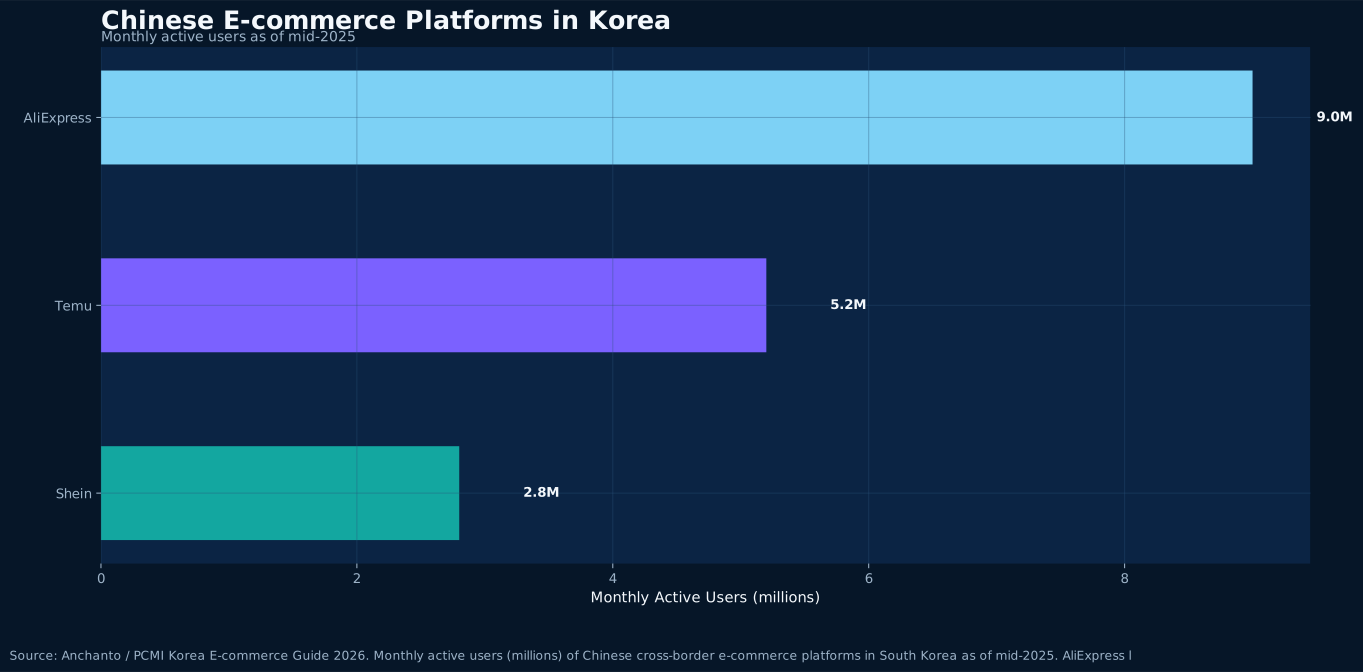
As of mid-2025, AliExpress had surpassed 9 million monthly active users in South Korea, making it the largest Chinese cross-border e-commerce platform in the Korean market. What does this number mean? Korea's total population is approximately 52 million, with about 38 million active online shoppers — AliExpress's penetration rate is approaching one-quarter. Notably, AliExpress's growth in Korea is not driven by low pricing alone but built on three competitive dimensions: first, SKU breadth — covering nearly every consumer category from electronics to home goods, apparel, and beauty; second, logistics acceleration — through an Incheon overseas warehouse and partnership with the Weihai-Incheon cross-border fast ship service, core category delivery has been compressed to 3-5 days; third, localization — including Korean-language customer service, KRW settlement, and deep integration with local payment tools like KakaoPay.
Temu follows at 5.2 million MAU, rapidly acquiring users through aggressive gamification marketing (group buying, price chopping) and ultra-low pricing strategies. SHEIN holds third place with 2.8 million MAU, with its core advantage being fast-fashion's extreme speed of new product launches — averaging over 6,000 new SKUs per day. The three platforms have different emphases but share a common trait: all are using Chinese supply chain scale and speed advantages to redefine Korean consumer expectations of 'value for money.' The stereotype that 'cheap means low quality' is being dissolved by massive volumes of actual purchase experiences.
2. 84% Annual Growth: Why Korean Consumers Keep Buying More
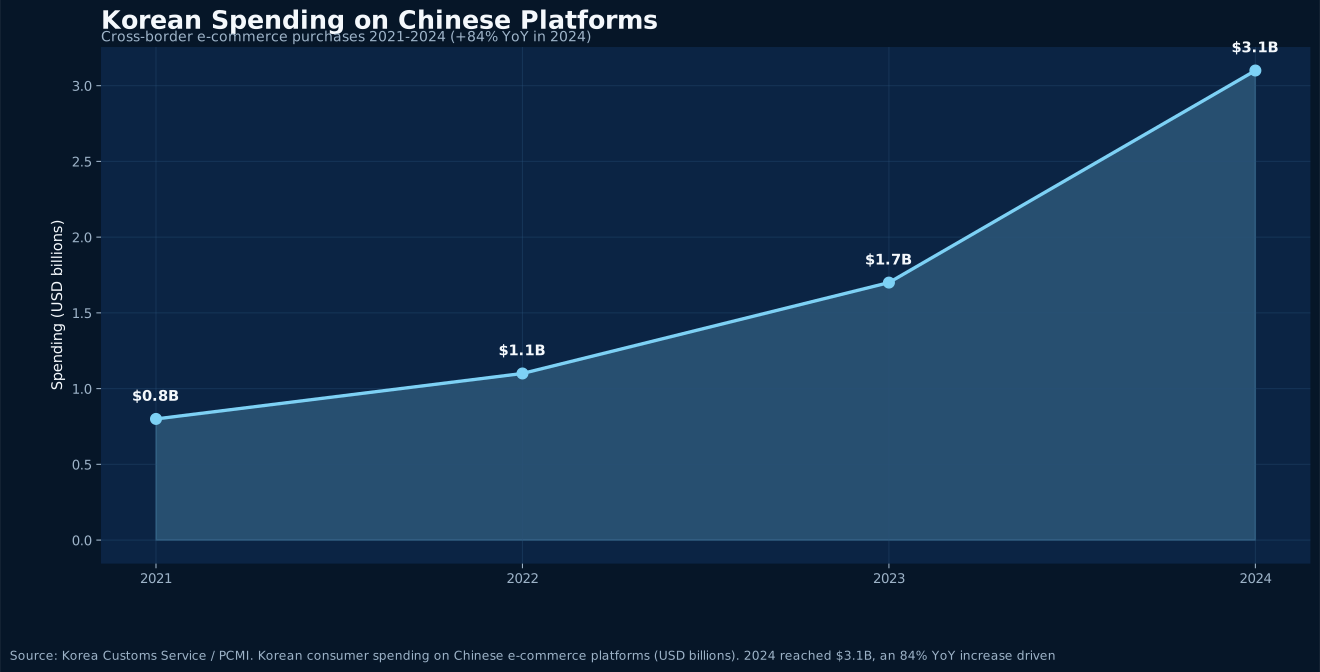
In 2024, Korean consumer spending on Chinese cross-border platforms reached $3.1 billion, up 84% from $1.7 billion in 2023 and nearly quadrupling from $0.8 billion in 2021. This growth rate is exceptional among major global e-commerce markets. Three core factors drive this growth: first, Korean consumers' extreme pursuit of value amid high domestic prices — Korean CPI stayed above 3% through 2023-2024, with food and daily necessities rising particularly sharply, while comparable products on Chinese platforms cost one-third to one-half of Korean retail prices; second, dramatically improved brand awareness of Chinese platforms in Korea — massive advertising by AliExpress and Temu across Korean subways, TV, and social media has effectively broken down psychological barriers; third, the 'repeat buyer effect' — once consumers complete a first purchase and have a satisfactory experience, repurchase rates increase significantly.
Notably, Korean consumer purchases on Chinese platforms are expanding from low-cost small items to medium and high-value categories. Early on, Korean consumers mainly bought phone cases and cables on AliExpress, but 2024 data shows significantly increased share of home appliances, beauty devices, sports equipment, and home furnishings. This means Chinese platform development in Korea has passed the 'trial' stage and entered the 'daily consumption' stage. For domestic Korean platforms like Coupang and Naver Shopping, this constitutes a substantive market share threat.
3. Logistics Revolution: The Infrastructure Race from 'Slow Shipping' to '5-Day Delivery'
The biggest bottleneck for Chinese cross-border platforms expanding in Korea was logistics speed. Before 2022, shipping from China to Korean consumers typically took 10-20 days — unacceptable for Korean shoppers accustomed to Coupang's 'Rocket Delivery' (next-day). But over the past two years, logistics infrastructure has undergone fundamental change. AliExpress established a large overseas warehouse in Incheon, enabling 48-hour dispatch for Korean orders; the Weihai-Incheon dedicated cross-border e-commerce fast ship compressed transit to 12 hours; and the China-Korea AEO mutual recognition agreement reduced customs clearance time by 60%. Together, these upgrades compressed end-to-end delivery for core categories to 3-5 days — still not matching Coupang's next-day service, but within the acceptable range for most Korean consumers.
SHEIN adopted a different logistics strategy — establishing regional distribution centers in Korea and Vietnam, pre-stocking popular SKUs closer to end consumers. This 'forward warehouse + cross-border' hybrid model enables SHEIN to shorten delivery while maintaining price advantages. More notably, Chinese platforms' logistics upgrades are forcing Korean domestic e-commerce players to invest more in optimizing their own delivery networks — Coupang announced 15 new logistics centers in 2026, and Naver Shopping is accelerating direct partnerships with Korean local couriers. The competitive pressure from Chinese platforms is actually elevating logistics service standards across Korea's entire e-commerce industry.
4. Korean Domestic Platforms Fight Back: How Coupang and Naver Respond
Facing Chinese platforms' aggressive entry, Korean domestic e-commerce is not standing idle. Coupang, Korea's largest platform with over 20 million MAU, is reinforcing its core advantages — logistics speed and after-sales service. Operating 180+ logistics points across 30+ Korean cities covering 70%+ of population centers, Coupang's 'Rocket Delivery' (same-day/next-day) remains a barrier Chinese platforms cannot replicate short-term. Coupang is also intensifying private-label and exclusive product development to offset Chinese platforms' price impact through differentiation. Naver Shopping leverages its search engine and portal traffic advantages, deeply integrating shopping with content — users can make purchase decisions while browsing news, blogs, and videos.
However, the real challenge for Korean domestic platforms comes not from any single Chinese platform but from the 'systemic advantage' of the Chinese cross-border model itself — built on China's manufacturing scale as the 'world's factory,' supply chain responsiveness, and digital marketing capability. Coupang and Naver can maintain leadership in logistics and user experience, but struggle to compete on source-product costs against platforms directly connected to Chinese factories. From a China-Korea trade perspective, the ultimate winner may not be any single platform but 'consumers' — Korean consumers will get more choices, lower prices, and faster delivery. For Chinese trade service providers, helping Korean businesses and consumers connect more efficiently with Chinese supply chains will be a sustained growth direction. Author: Minghao, MO-TEK International Trade (Shanghai)
5. New Opportunities for China-Korea Trade Services: Ecosystem Value Beyond Platforms
Chinese cross-border platforms entering Korea bring not just product flows but an upgrade of the entire trade ecosystem. In logistics, China-Korea sea freight, air freight, and warehousing demand continues growing — Korea's cross-border e-commerce logistics market was approximately $5.4 billion in 2024, projected to reach $23.5 billion by 2030 (CAGR 28.4%). In payments, cross-border settlement demand is creating new financial service opportunities. In compliance, Korean consumer protection regulations are tightening for cross-border e-commerce — product certification (KC certification), return policies, and consumer data protection requirements are creating rigid demand for professional service providers.
For China-Korea trade service firms like MO-TEK, the core opportunity in the platform era is not becoming a platform but becoming an indispensable service node within the platform ecosystem — helping Chinese suppliers understand Korean consumer preferences and compliance requirements, helping Korean buyers connect with quality Chinese supply chains, and providing one-stop solutions from product selection and certification to logistics and after-sales. With Korea's live commerce market projected to exceed $4 billion by 2030 (36% annual growth) and Korean consumer acceptance of Chinese goods continuing to rise, service demand in China-Korea cross-border e-commerce will only grow.