1. From IEEPA to the Supreme Court: The Roller-Coaster of US Tariffs on Korea
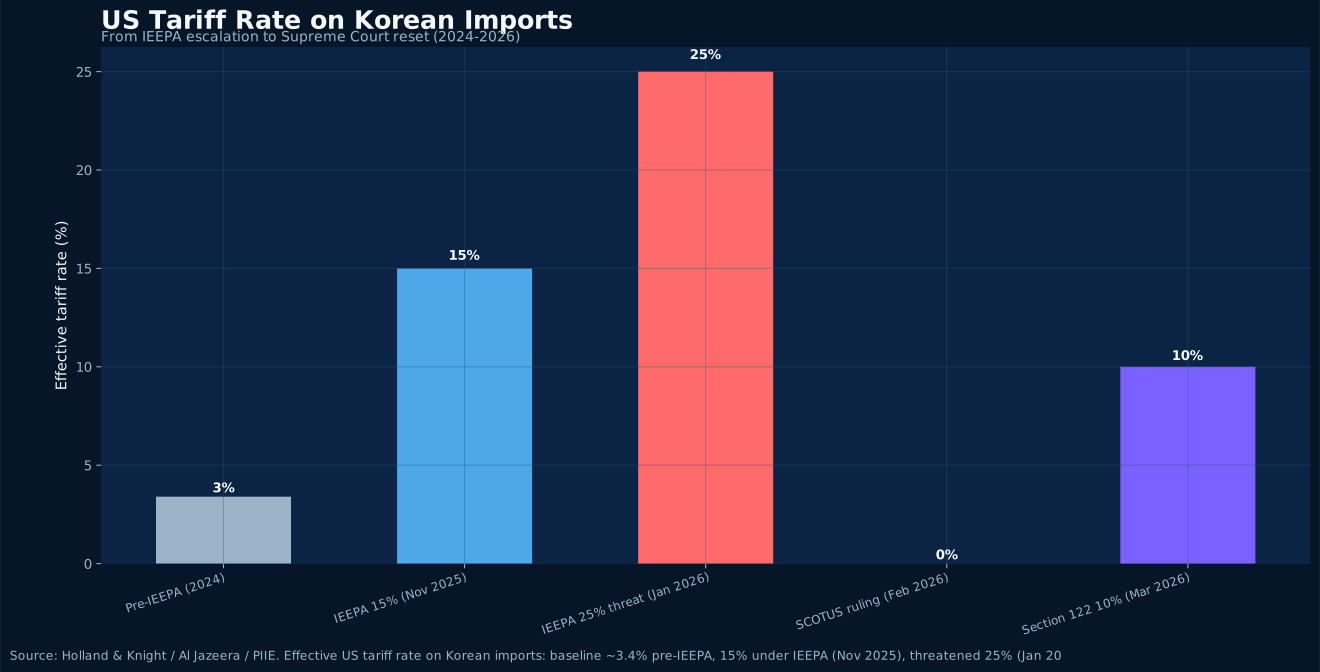
In the second half of 2025, the Trump administration invoked the International Emergency Economic Powers Act (IEEPA) to impose tariffs on multiple trading partners, including South Korea. Effective November 1, 2025, Korean goods faced a 15% IEEPA tariff, shattering the low-rate equilibrium under the US-Korea Free Trade Agreement. Just over two months later, on January 26, 2026, Trump announced he would raise tariffs on Korean automobiles, lumber, and pharmaceuticals to 25% because Korea's National Assembly had not ratified the bilateral trade agreement. This threat alarmed Korean exporters — Korea's exports to the US totaled $123 billion in 2025, with automobiles accounting for 27%, meaning any rate increase would deliver a massive cost shock.
The turning point came on February 20, 2026. In Learning Resources, Inc. v. Trump, the US Supreme Court ruled 6-3 that IEEPA does not authorize the President to impose tariffs. Chief Justice Roberts' majority opinion stated clearly that IEEPA grants emergency economic sanctions authority, not trade-regulation power. The immediate consequence: all IEEPA tariffs terminated at midnight on February 24, and approximately $175-179 billion in collected duties faced potential refund. For Korean exporters reliant on the US market, this was a significant relief. However, the White House immediately announced a 10% global replacement tariff under Section 122 of the Trade Act of 1974, signaling that tariff pressure had not fully dissipated.
2. The $350 Billion Deal's Legal Limbo: Korea's Dilemma
During the IEEPA tariff period, Korea made a major concession to secure tariff relief — publicly pledging approximately $350 billion in US-directed investment across semiconductors, batteries, and auto manufacturing. This was essentially an 'investment-for-market-access' arrangement. But after the Supreme Court ruling, a fundamental question surfaced: if these tariffs were unconstitutional to begin with, is Korea still obligated to honor investment commitments predicated on them? As the Stimson Center noted, for an economy where trade accounts for 85% of GDP, this legal gray area creates unprecedented strategic uncertainty.
Adding complexity, while the Section 122 replacement tariff is lower at 10%, its legal authority also faces challenges — Section 122 limits the President to 150 days of temporary tariffs without Congressional approval, capped at 15%. This means the replacement tariffs could face legal scrutiny again around July 2026. For China-Korea trade practitioners, the uncertainty itself is a variable that must be factored into supply chain planning — regardless of the final rate, the constant flux in tariff regimes is driving up compliance costs and inventory management complexity.
3. The Deep Structure of the US-Korea Trade Deficit: Why Automobiles Are the Eye of the Storm
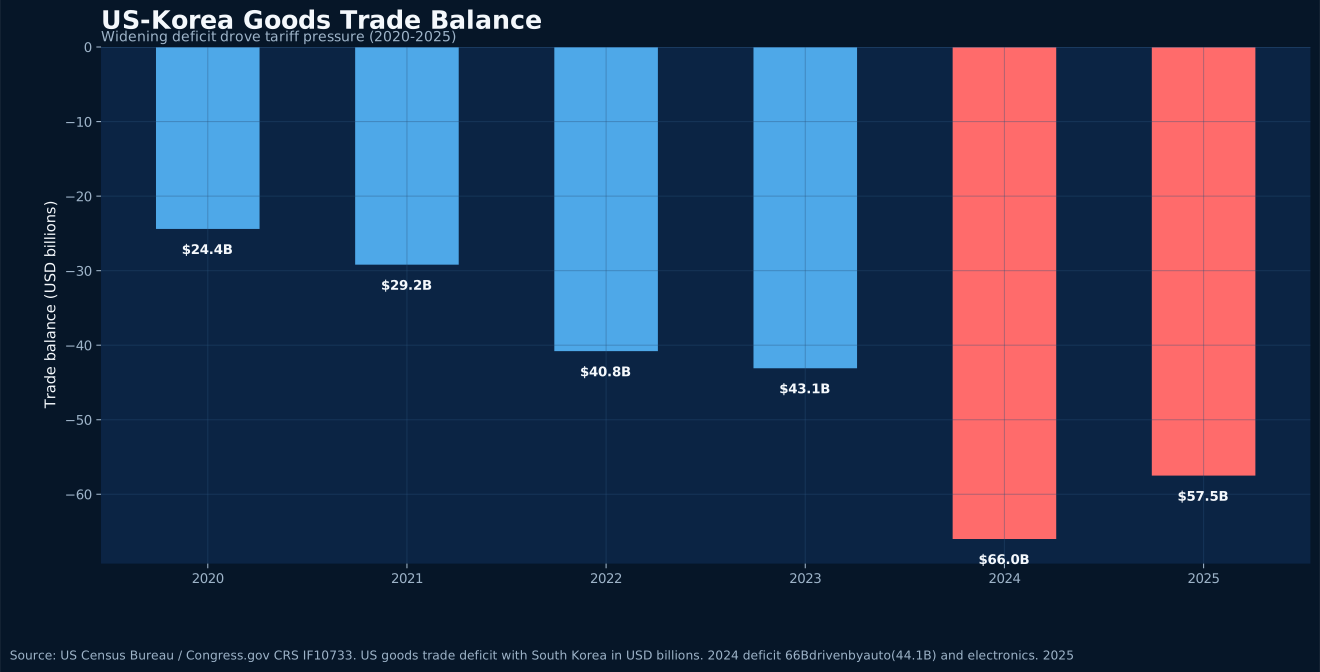
To understand why IEEPA tariffs specifically targeted Korea, one must examine the US-Korea trade deficit structure. In 2024, the US goods trade deficit with Korea widened to $66 billion, with automobiles alone contributing $44.1 billion — two-thirds of the total. Korea exported 1.43 million vehicles to the US in 2024, with Hyundai and Kia continuously gaining market share. This highly concentrated deficit structure made automobiles the politically most sensitive target. For the Trump administration, pressuring Korea offered political returns exceeding economic costs — projecting 'toughness' to domestic manufacturing voters while extracting investment and market-opening concessions.
Yet the other side of US-Korea trade also deserves attention. Korea is the 7th largest US trading partner, with bilateral trade exceeding $201 billion in 2024. Korea's imports of US energy, agricultural products, and aerospace equipment form significant complementary trade flows. Excessive tariff confrontation could actually harm US export interests. After the Supreme Court ruling, both sides need to find a new equilibrium that narrows the deficit without destroying the mutually beneficial trade framework. For Chinese exporters, whenever US-Korea relations enter an adjustment period, Korean buyers tend to intensify inquiries with Chinese suppliers — not to 'replace' American goods, but to diversify supply channels and hedge single-market policy risk.
4. Transmission Effects on China-Korea Trade: A Window for Supply Chain Reorganization
The IEEPA tariff turmoil's impact on China-Korea trade is indirect but profound. When Korean exports to the US face high tariff risk, Korean manufacturers begin reassessing global supply chain layouts — if US market margins are severely compressed by tariffs, should more capacity and attention shift to other markets? China, as Korea's largest trading partner (bilateral trade exceeded $300 billion in 2024), naturally becomes the first choice for 'hedging US risk.' We observed that in Q1 2026, Korean corporate attention to the Chinese market rebounded notably, especially in consumer goods, intermediate goods procurement, and cross-border e-commerce.
Second, the erratic US tariff policy is accelerating East Asian exploration of 'de-dollarized' trade settlement. China and Korea already have framework arrangements for local-currency settlement, and the greater the tariff volatility, the stronger corporate demand for stable settlement channels. Furthermore, the Korean government accelerated services trade opening discussions with China in FTA Phase 2 negotiations after the IEEPA episode — this is not coincidence but strategic hedging. For businesses engaged in China-Korea trade, this is a rare window: Korean buyer receptivity to Chinese supply chains is rising, and the compliance framework is becoming clearer as the FTA deepens. Seizing this window requires not just price competitiveness, but rapid responsiveness to shifting Korean market demands. Author: Minghao, MO-TEK International Trade (Shanghai)
5. Compliance Advice in the Tariff Aftermath: Three Practical Paths
Facing a continuously shifting US tariff environment, China-Korea trade businesses need to build a three-layer response mechanism. Layer one is 'tariff scenario planning' — do not assume any rate is permanent, but prepare pricing models and inventory strategies for four scenarios: 0%, 10%, 15%, and 25%. Layer two is 'certificate of origin management' — in a volatile tariff environment, accurate origin documentation matters not only for rate application but also for refund eligibility. After IEEPA tariffs were ruled unconstitutional, importers can claim approximately $175 billion in refunds, but only with complete import records and certificates of origin.
Layer three is 'accelerated market diversification' — the biggest lesson from the IEEPA episode is that over-reliance on a single export market leaves businesses extremely vulnerable to policy shifts. For Korean firms, expanding into China, ASEAN, and Middle East markets has moved from 'optional' to 'essential.' For Chinese firms, this is precisely the right moment to deepen cooperation with Korea. When Korean companies actively seek supply chain diversification, Chinese suppliers who offer stable quality, complete compliance documentation, and fast response times will gain significant competitive advantages. MO-TEK International Trade advises clients to closely track Section 122 legal developments and US-Korea trade agreement renegotiation dynamics, as these will continue shaping China-Korea trade patterns over the next 6-12 months.